![unnamed[3]](https://live.staticflickr.com/65535/49601777453_c7dbe04488.jpg)

Corena Maylona Landess came from a line of people who believed in family. Corena’s grandfather Abraham Landess was an example of this mindset. When children or grandchildren needed his help, he was there. He led many of his family on the Oregon Trail, looking for something just over the horizon. He came to Oregon in 1847. He kept his family intact at all cost. He gave himself for his family. But Corena strayed off this path, perhaps it was her disenchantment with her first husband. Or maybe she had childhood trauma beyond the norm. Perhaps she wasn’t ready for motherhood. She tried to express herself in her poetry, but somehow couldn’t get a grip on her life. Nonetheless, she played her part in the rolling thunder and gentle tides of the family genealogy.
No family line is free of problems and scandals. No person is. Digging deep into ancestral lines oftentimes leads to various conflicts of human behavior. One needs to be careful about judging too deeply into the lives of others. A good look in the mirror might help.

Ancestry.com by Don Guenther
![unnamed[2]](https://live.staticflickr.com/65535/49552942047_a5b2af4aa6_c.jpg)
Derivation of the Name Landis
The name Landis came from ‘land’ plus ‘oesen’, highwayman, a robber, and land destroyer. The original spelling was Landoes. Landos > Landis > Landers > Landess. One of the variants is in fact Landis.
“German and Swiss German: nickname for a highwayman or for someone who lays waste to the land, Middle High German landoese.” ( Source: Dictionary of American Family Names ©2013, Oxford University Press )
Another source says the name was derived from growers of lavender.

Abraham went by Landers until they got into Oregon in 1847 when his son John changed to Landess.
Swiss Background
Hans Henrich Landis(1553-1614) was born in 1553 in Horgen, Zurich, Switzerland. This was Landis country, and even though it has not been positively determined that Hans is in the direct line of the Guenther ancestry, he is a relative worth noting. He was a preacher for the Swiss Brethren. These were the Anabaptists, the Mennonites, a God fearing gentle people. Hans married Margaret Hochstrasser(1554-1580). His refusal to bow to the state religion landed him in jail twice. Landis was labeled “stiff-necked”.
Hans was offered immigration, but his strong faith kept him in his home country. He was quoted as saying that the earth was the Lord’s; no one had authority to send them away, they were going to stay in Switzerland.

Twice Hans escaped from prison. Then on December 13, 1613, he was seized again and put to the excrutiating torture of the rack. On September 29, 1614, Hans was sentenced to death. His crime was his inflexible belief in God and the Bible. Religious freedom was not to be found in Switzerland in 1614. The next day his wife and children came to say their goodbyes, but Hans, fearing his weakness with their presence, asked them to leave. But weak he was not; the executioner asked for Hans to pardon him, at which point Hans said he had already forgiven him.
At that point the executioner raised his sword, and with a mighty stroke, severed Hans’ head completely from his body. Hans just kept right on living, his faith intact.
Their tenets include no infant baptism, refusal to take oaths, bear arms, or to fill civil offices; and they practiced humility. To the godless state church, this constituted an unforgivable sin worthy of death. Many fled Switzerland for Germany and elsewhere.
Many of the descendants of Hans Landis, the martyr, died in prison or from harassment. Several of his grandchildren managed to immigrate from Switzerland and went to Alsace, paralleling the Rhine River, and at that time a part of Germany. Today Alsace is a part of France and that is why you sometimes see their heritage given erroneously as French. By 1730 the first Landis was in America.
Over 100,000 Germans migrated to the English colonies in North America. Most of them settled in Pennsylvania. They formed the largest non-English-speaking community in colonial North America.
Germany had been ravaged by war in the 17th century, making immigration look inviting. These people were looking to leave something behind as much as looking to what was ahead. With the ravaging of Germany came ruined farms, much theft, famines, and the general devastion caused by marching armies. Freedom of religion was being practiced, and taxes to fund the wars were high.
Hans Jacob Landis(1667-1730)

Hans Jacob was born in 1667 in Steinfurt, North Rhine-Westphalia, Germany. Hans married Anna Whitmer(1671-1725). At some point he crossed the Atlantic. Many Germans and particularly Mennonites headed for Pennsylvania. He died in 1730 in East Lampeter, Lancaster County, Pennsylvania, USA. They had Felix in 1690. It is thought they also had a son named John.
Felix Landis(1690-1737)
Felix was born in 1690 in Steinfurt, North Rhine-Westphalia, Germany. He married Marie Landeau. He died in 1737 in Heppenheim an der Bergstrasse, Bergstrasse, Hesse, Germany. They had Christopher in 1710.
Christopher(Christian) Landis(1710- 1771 )
Christopher was born in 1710 in Manheim, Erftkreis, North Rhine-Westphalia, Germany. He married Mary(1720-1771). He died in 1771 in Mecklenburg, NC, USA, having followed his grandfather to America.
Christopher and Mary had 7 children, including Felix in 1758.
Felix Landess(1758-1814)
Felix was born in 1758 in Greenbrier County, West Virginia. He died in 1814 in Monroe County, Indiana. Felix and his wife had 4 children including Henry, born in 1780, who fought as an ensign in the War of 1812 in the Casey County militia in Kentucky; and Abraham in 1789.
Abraham Landess(1789-1855)
Abraham was born in North Carolina where he lived from about 1788 to 1800. He moved with his father to Liberty, Casey County, Kentucky, where he married his neighbor, Elizabeth Conkwright(1795-1876) on February 24, 1811. They remained in Kentucky until 1838. He was a wagon maker by trade. Abraham and Elizabeth had all their children in Liberty.
![unnamed[2]](https://live.staticflickr.com/65535/49637519612_4f1e49609b_c.jpg)
1840 Census, Liberty County, Kentucky
In 1838 they moved to Quincy, Illinois, and lived until 1847. They probably moved to Quincy at the same time as Abraham’s father-in-law, Isaac Conkwright. Isaac settled in nearby Pike County. Doubtless they were neighbors at the county line or at least close to each other.

The Landess story is a story about a large family that started out in Kentucky and migrated to Oregon. They helped each other out all the way. If one went down another would step in to fill the void. They stuck together as a family. In Quincy they went by Landers, but on the Oregon Trail they became Landess, for whatever reason.
Adams County, Illinois

Abraham Landess was a typical man of the frontier, in some ways outstanding. He signed with an ‘x’, but in that day this did not necessarily imply illiteracy. It may have signified bad eyes, but he was only 48 when this was signed in 1837.
Abraham and his family lived in Adams County Illinois, in a log shanty in 1832. Below is a picture of that property, now developed by a man named Degroot, who purchased the property from Landess.

Property of Abraham Landess in Adams County, Illinois, 1832, Improved by a Purchaser named Degroot
Illinois Digital Archives in 1836
Conkright Line


Tree by Donald S. Guenther
17th Century Dutch, The Netherlands
The Dutch stood for freedom of religion and speech. In the 1600’s The Dutch were master ship builders. They were also at the height of their cultural and trading dominance, the Golden Age. Amsterdam in 1614 was a new haven for artists and intellectuals. Some say they were more refined than London, at the time, the University of Leyden was much more important than Oxford. A refuge for talent!

Google Map edited by Donald S. Guenther
But the idea of liberty…to own a business…to make money and be free to believe and worship God in whatever way was in their heart, these were Dutch ways, at the time.
England was very concerned with the Anglican Church, the Dutch not so much. The Dutch fought three sea wars with England at this time and won two of them. Our ancestors were in the thick of it. An uninterested party would be quick to point out the flaws in the Dutch system, but the Conkwrights were Dutch.
In 1609 the Dutch hired a man by the name of Henry Hudson to explore the new world for them and help them find a place to settle. When Hudson came upon the New York area he noted a ‘long island’, and a great river that he called the River of the Mountains but later it was changed to the Hudson River. This would be the ideal place for the Dutch to get a foothold in America. They would trade in furs and establish farms.
The Dutch coming to New Amsterdam, or New York, were a goodly people in the main and tried to get along with the local Indians; however, their first governor was William Kieft, and his nick name was William the Testy’. He incited Indian trouble and successfully started an exterminating process of the tribes. The Wappinger Indian wars of 1643-1645 are attributed to Governor Kieft. Kieft instigated horrible massacres.
In 1600 the seven Wappinger tribes numbered somewhere about 8,000 in 30 villages. After contact, the rate of their “melting away” was dramatic. Smallpox struck the area from 1633-35 and 1692. By 1700 epidemics,including malaria, had reduced the lower Hudson tribes to 10 per cent of their original number. No question about it the Indians weren’t handled properly and in this case many were murdered. Most of the Indians died from disease. To be fair, the Indians were also cruel to the newcomers.
Hendrick Harmensen (1590-1643)
Hendrick and Tryn Harmensen were our 9th great grandparents that came to New Amsterdam, America in about 1615.
By ARTHUR WHITE: Nearly 300 years ago Hendrick Harmensen, commonly known as Henry the Farmer, and his wife. Tryn Herxker, were living in a little cabin on the shore of Bowery Bay, now known as North Beach. All around them was an unbroken wilderness inhabited only by Indians and wild animals, and at night while sitting In front of the great open fireplace, all they could hear were the howl of the wolf and the lapping of the waves on the beach. ( THE DAILY STAR, LONG ISLAND CITY, QUEENS BOROUGH, N. Y., MONDAY EVENING, DECEMBER 1, 1930)
With no white neighbors within miles of them, theirs was a lonely life, but Henry’s big farm, which included nearly all of the present North Beach, kept him busy during the day and, having been an armorer for the government in his old home In Holland and much skilled In the making of iron weapons, he would spend his leisure hours manufacturing tomahawks for gifts to the Indians round about him. But his generosity cost him his life In the end, for during the Indian uprising in 1643 he was killed by one of his own weapons thrown by the hand of a savage. These Iron tomahawks were quite a curiosity, for besides having an axe like blade, they were equipped with three sharp points, one at each end of the handle and one at the back of the blade, so If thrown at an enemy It was certain to make its mark, and generally a fatal one.

The Star-Journal reported on May 14th 1880 that one gardener had found an interesting relic of older times. “Mr. John Mahoney, steward of the old Riker homestead on Bowery Bay, while digging in the garden, was much surprised on exhuming a battle axe of Indian days. Mr. Mahoney, who is an attentive student in the history of Newtown, identified the weapon as the very tomahawk which had been imbedded by an Indian into the brain of Hendrick Harmensen, the original proprietor of the Riker farm.” Harmensen, a Dutch settler in the early 1600s, had a sideline forging axes for the local Indian tribes, and legend has it that he was killed with one of his own tomahawks.Hendrick’s had a daughter, Gretie Harmensen.
Gretie Margaret Harmensen
Gretie married Abraham Rycken; it is after this prominent Queens family that Rikers Island is named. Mr. Mahoney, it appears, “fully expected to have drawn up the cleft skull of the ancient Riker, for history does not record that Hendrick Harmensen ever had received the rites of Christian sepulture in the old family cemetery. In truth he, Mr. Mahoney, was much disappointed at not finding the human remains of Harmensen.” The alleged murder weapon, it was reported, had been presented to the Long Island Historical Society.
Gretie’s daughter, Marytie Rycken married Sybout Herricksen, son of Herck Siboutszen and Wyntie Tuenis Quick

Harmensen land on left.
Herck Siboutszen(1620-1681)
Herck Syboutssen was born around 1620 in Langedyk Zevenwolden, Netherlands, located on a peninsula in the north. He died about 1681 at the age of 66 in Newton, Long Island, New York. His father was Sybout Herck who was born in Langedyck, Holland, near the Kuinre River in the Zevenwolden, or the Seven Forests region. In his youth Herck Siboutszen learned the trade of Scheepstimmerman, ship’s carpenter. In 1641 he crossed the Atlantic, living near the Heeren Gracht , just off Astoria Boulevard in modern day New York, in New Amsterdam, next door to Abraham Riker , who had also come from Holland but was of German ancestry.
In about 1649, Herck bought 21 morgens, about 42 acres, of land in the northwest corner of Long Island, in an area that came to be called Newtown and is now part of the Burrough of Queens. Herck and his neighbor Abraham de Riker seem to have become good friends while living in New Amsterdam, because the two men bought adjoining farms in Newton, near the Armen Bouwerie, or poor farm. The Dutch in those days called the Bouwereie a farm, usually a dairy farm. The farmers of this time in New Amsterdam were a poor people. It is known that the area in New York City called the Bowery was once the Bouwereie and was a dairy farm. Herck cut his farm out of pure wilderness, and on July 2, 1654 he received his patent, or title, to the land from the New Netherland government. He later bought an additional 16 acres which were patented to him on April 18, 1644.


In 1656 The Riker family had a house built in East Elmhurst. It is believed that their neighbor, Herck Syboutssen, built it. It is the oldest home in America that has been continuously lived in. It is the Lent-Riker-Smith Homestead and is an American landmark.


The area where Herck had settled was well within the Dutch colony, but only a few Dutchmen had settled there. A good many English had filtered in from Massachusetts, Rhode Island and Connecticut, where they had found the religious oppression by the Pilgrims and Puritans as bad as it had been in England. In Holland and in the Dutch possessions there had always been tolerance. However, because there were so few Dutch in Herck’s area, it took some eighty years before a Dutch Church was built there. But the Dutch took easily to water, and the Cornelieszens, Ryckens, Luysters, Syboutszens, Webbers and Wiltsees, all living near the Armen Bouwereie and next to navigable waters, found it easy to simply sail to church for services, baptisms and marriages. A few went to Bushwhyck or Harlem, but as late as 1686 most were attending the Dutch Church in New York City.
On November 16, 1642 Herck married Wyntie Theunis Quick in the Old Dutch Church of Sleepy Hollow. Born in Naarden, Holland on 23 July 1628 , the daughter of Theunis Thomas Quick de Metselaer and Belitje Jacobs van Vleckersteyn, Wyntie and had crossed the Atlantic to America with them. She is said to have been a great beauty and “the toast of the town”. Living in New Amstredam, a port city which became New York, Herck would have had plenty of work in the ship yards building ships for the busy port and for Hudson River travel.

17th Century Dutch Attire ( Marianna, 2014 )
Wyntie bore fifteen children with Herck. In 1680 she sponsored her granddaughter’s baptism, Wyntie, daughter of Sibout oldest son of Herck and Wyntie. She died in 1689 at the age of 61.

When the Dutch first established a town on the southern end of Manhattan Island, they named it “New Amsterdam”, and it remained so until 1664, when an English fleet sent by James, Duke of York and brother of the king, arrived. The Dutch were ill-equipped to fight, and had no choice but to surrender. New Amsterdam became New York, and Herck became an Englishman whether he wanted to or not; all citizens were required to take an oath of allegiance to England. Two years later, when the English governor re-confirmed land titles, Herck was listed as a “Freeholder of Newtown”. The city was re-named “New York” in honor of the Duke. In August, 1673 the Dutch, who were then at war with England, captured the colony again, calling the city “New Orange”, but the peace treaty made in the summer of 1674 gave it back to England, and again it became New York, this time for good.
It looks like the Dutch were trying to claim America when they founded New Amsterdam, or modern day New York. They just didn’t have the fire power and navy to hold it. But they tried. The English alsotried to claim America and they couldn’t hold it. America was destined to be held by free Americans.
The last twelve children of Herck and Wyntie were all born on the farm near the Armen Bouwerie. When Joseph, the last child, was born in 1681, Herck was somewhere around 41 years old. He is thought to have died about 1681 at age 61. He died on his farm, which was taken over by son Jacob.
The children of Herck Syboutssen and Wyntie Theunis were all baptized in the Reformed Dutch Church of New Amsterdam or New York City. They were:
1. Sibants (Sybout), baptized 12/4/1644; sponsors were Sybant (Sybout) Claessen (probably 1st cousin of Harck Syboutsszen), Hendrick Jacobsen, the child’s uncle, and Sara Schepmoes. He married Marritje Abrahams, daugher of Abrahanm de Rycke, in the Dutch Reformed Church in New York City. He later moved to Westchester County, settled first on Ryck’s Patent and then Pillipsburgh Manor. Joined the Dutch Reformed Church of Sleepy Hollow, and was an elder there from October 277, 100 until August 20, 1702.
2.Maryken (Mary), bap. 11/10/1647; sponsors Theunis de Metsslaer (her grandfather), Reynier Dominicus, Claes Janszen and Belitje Coprnelis. She married Evert Aertszen on February 2, 1673.
3. Tryntje (Catharine), baptized 1649-50 (between January and March). On February 2, 1673, she married Ryck Abrahamsen Lent (son of Abraham de Rycke) at the Dutch Reformed Church in New York City. She and Maryken appear to have had a double wedding.
4. Beelitjen, bap. 2/4/1652; sponsors Lamberty Huybertszen, Jacon Teuniszen (her uncle), Jan Janszen and Belitje Jacobs, her grandmother. On May 19, 1575 she married Conraet ten Eyck, Jr., in the Dutch Reformed Church, New York City;
5. Engeltje, bap.l 5.17/1654; sponsors Jochem Calder, Dircki Janszen, Susanna Jans (wife of Sybout Claeszen), and Annetjen Lodowycks. On June 13, 1677 she married Pieter Brestede at the Dutch church in New York; he died and she married Jan Evertszen on May 4, 1686, in the same church. When Jan died she was married a third time to John Wendover.
6. Theunnis, bap. July 4, 1655; sponsors Arie (aaron) Dirckszen, Jocham Calder, Belitje Jacobs (grandmother),and Susanna Jans. Teunis married Antje Banckert, moved to PHillipsburgh, and was a member of the Sleepy Hollow Dutch Reformed church. He died in 1709
7. Jan (John), bap. 11/28/657; sponsors Pieter Syboutszen, Jaconb Theuniszen (his uncle), Grietje Huddens, and Belitje Jacobs, his grandmother. He married Sophia Wiltsie of the well known Wiltsie family who first settled in New Amsterdam.
8. Jacobus (James), bap. 9/7/1659;l sponsors Jacob Teuniszen de Key and Aeltje Willems. He married Elisabeth Hegeman on September 17, 1684 (she was a widow). He calls himself a yeoman. Robin Hood also called himself a yeoman. That meant a free farmer with some land and maybe other property.
Jacobus Kronckheyt’s Will:
Will of Jacobus Kronckheyt yeoman of Newtown, in Queens County, being in good heath but knowing that all flesh must yield to death. All debts are to be well and truly paid. I leave to my nephew Abraham Lent of Westchester County, son of my sister Tryntie, deceased, all that messuge, tenement and Plantation on which I now dwell (the homestead of his father Harck Syboutsen) in Newtown at or near a place called and known by the name of ye Poor Bowery. With all lands and meadows, salt and fresh, to the same belonging. And he is to pay to my son-in-law Jacob Ten Eyck, 60 pounds sterling soon after my decease. And he is to pay to my brothers, Sybeth and John Kronckheyt, and to Arisen and Beltie Ten Eyck, Engeltie Windeford, Aertie Van Voorst and to Henry Juman, son of my sister Jannettie and to Ariantie Ryder and Wyntie Hoff, each 5 pounds sterling. And he is pay to the children of my sister Killetie Fredericksen, deceased, 3 pounds sterling. I leave to my nephew Peter Luyster, of Oyster Bay, son of my sister , Wyntie Hoff, a mulatto girl named Molly. I leave to my niece, Margaret Snediker, a bedstead amd bed, with ye proper furniture, and my new cupboard. All the rest of my household goods I leave to the children of my deceased wife Elizabeth. All the rest of my estate I leave to my brothers Sybeth and John and my nephew Henry, son of my brother Teunis and to my sisters Maritie, Beltie, Engeltie, Antie and my nephew Henry son of my sister Janettie and to my sister Ariantie and the children of my sister Hillitie and to the said Abraham Lent. I make my nephew Abraham lent and my friend Samuel Fish , of Newtown, my executors. Dated Nov 18, 1728 Witneses Andies Reike, Beter Berrien, one name illegible Proved March 3, 1729. Jacob’ Will (WIKITREE . 2008-2015)
9. Annetie, bap. April 19, 1662; sponsor Hillegond Theunis, probably her aunt. Annetie married Johannes Van Vorst on August 26, 1685 in the Dutch Church at New York City.
10. Jannetje, bap. August 3, 1664; sponsors Jacob Theuniszen Cray, Pieter Janszen, Geertie Theunis (her aunt). Jannetje married 1st John Pinkens in 1685. she then married, 2nd, a man named Yeomans.
11. Arisentie, bap. June 4, 1666; sponsors Jacobus de Key, Marritie Levens. On July 27, 1690 she married Jan Ryder at the Dutch Church in New York City.
12. Hilletie, bap. 4/22/1668; sponsors Jonas Bartelszen, Tryntie Wemeyer Frederickese. She married 1st Jan Snediker, and 2nd, a man named Frederickse, who was probably related to her sponsor Tryntie.
13. Pieter, bap. 3/22/1670; sponsors Jacobus de Key, Geertie Theunis. He is presumed to have died young.
14. Weyntie, bap. 3/27/1675; sponsors Karsten Luurzen, Engeltije HJercks (her older sister). She married 1st John Luyster in 1694, and 2nd, Peter Hoff (or Haff) in 1699-1700 (this would be between January 1st and April, 1700).
15. Joseph, bap. 8/6/1681. the record reads “geengetuygen” (no witnesses). He probably died before 1728.
Sybout Herrickse Cranckheyt(1644- )
Sybout Herricksen Cranckheyt was the eldest son of Herck and his wife, Wyntje Theunis. He was baptized on December 4, 1644, in New Amsterdam. In April 1669 he married Marytje Abrahams Riker, who had been baptized on February 21, 1649, in New Amsterdam. She was the daughter of Abraham Rycken and Grietje Hendricks.

In 1684 Sybout joined with his Lent brothers-in-law in the purchase of Ryck’s Patent, now a part of Peekskill. He lived at the Arme Bouwery until about 1790 when he moved to the “Bay of Cortlandt.” Sybout and Marytie Kranckheyt are 8th and 9th on the member list of the Sleepy Hollow Reformed Church.


Sibout and his wife, Marytje, had eight children, all of whom were baptized in New York City in Sleepy Hollow. The baptismal records record the following:
1. Herck, April 17, 1670. Sponsors: Theunis Thomaszen and Belitje Thomas.
2. Marritie, October 28, 1672. Sponsors: Herck Siboudtszen and Marrietie Hercks.
3. Abraham, August 16, 1676. Sponsors: Everet Aertszen and Marrietie Herck. He married Antje Broeckhout.
4. Wyntie, May 1, 1680. Sponsors: Herck Siboutzen and Wyntjie Theunis.
5. Annetie, March 19, 1684. Sponsors: Pieter Janszen and Jenneken de Key. She married Jan Beesby.
6. Herck, November 20, 1687. Sponsors: Jan Hercxen and Adrianetie Hercx. His name was Herck, or Herrick Siboutsen (son of Sibout) Krankheyt. From him we get the family name, “Conkwright.”
7. Jan, November 20, 1689. Sponsors: Jacobus de Key and Anneken Hercx.
8. Hilletje, April 30, 1693. Sponsors: Johannes Van Vorst and Tryntie Hercx. She married Frank Beesby.
Herck Sybout Cranckheyt(1670- )Herck Syboutsen Krankheyt was the son of Sybout Herricksen and Marytje Abrahams. In 1712 he married Fytje de Ronde, the daughter of William Hendricxen and his wife, Magdalena Helena Brouwer. They had seven children, all baptized at North Tarrytown , also called Sleepy Hollow, New York:
1. Magdalena, March 24, 1713. Sponsors: Willem de Ronde and Grietje Brouwer.
2. Maritje, June 11, 1715. Sponsors: Sybout Kranckheyt and Maritje Echer.
3. Zybout, April 18, 1716. Sponsors: Zybout Harckse Krankeyt and Marryetie Ecker.
4. Willem, April 22, 1718. Sponsors: Willem de Ronde and Altie de Ronde.
5. Abram, June 19, 1723. Sponsors: Abram Ecker and Rahel Lent.
6. Henreck, June 19, 1725. Sponsors: Henreck de Ronde and Catherine, his wife.
7. Herculius, June 24, 1727. Sponsors: Herculius Lent and Cornelia, his wife. More
Hercules Conkwright (1727-1809)
Hercules Conkwright was born in 1727 in Tarrytown, Westchester, New York. He married Dorothy Arckje(1725-1805) around 1755. He was baptized in the Old Dutch Church in Sleepyhollow, New York. The church was built in the 17th century.

Sleepy Hollow is a village in the town of Mount Pleasant in Westchester County, New York. The village is located on the east bank of the Hudson River, about 30 miles (48 km) north of New York City, and is served by the Philipse Manor stop on the Metro-NorthHudson Line.
The village is known as the setting of “The Legend of Sleepy Hollow” (the short story of a headless horseman), by Washington Irving in 1820, who lived in neighboring Tarrytown and is buried in Sleepy Hollow Cemetery. Originally incorporated as North Tarrytown in the late 19th century, in 1996 the village officially adopted the traditional name for the area, known to many via “The Legend of Sleepy Hollow”. To the south of Sleepy Hollow is the village of Tarrytown, and to the north and east are unincorporated parts of Mount Pleasant. The population of the village at the 2010 census was 9,870.
The village is also home to the Philipsburg Manor House and the Old Dutch Church of Sleepy Hollow, as well as the Sleepy Hollow Cemetery, where Washington Irving, Andrew Carnegie, Walter P. Chrysler, Brooke Astor, Elizabeth Arden, Thomas J. Watson ofIBM, Samuel Gompers, and many others are buried. ( Sleepy Hollow, New York, 2015 )

Old Dutch Church in Sleepy Hollow (Cole, 1697 )
Hercules appeared in the Colonial Records of Anson County, North Carolina, as one of the”Regulars” opposing Governor Tryon in 1768 in the Colonial War of the Regulation. He can be found on the Guenther War Wall. In about 1786 Hercules sold land and is thought to have moved to North Carolina in Cabarrus County. There they bought land but by 1788 they can be found on the tax list for Fayette County, Kentucky. Kentucky became a state in 1792, the same year that ClarkCounty was formed from Fayette County. In 1793 Hercules Conkwright is listed in the tax records of Clark County.
On July 11, 1801, “Dolle Conkright” was”received by experance” in the Providence Baptist Church, near the Kentucky Rover. Then, on February 13, 1802, there was this entry:”Whare as Dolle Conkright being a member of this church rending herself from sd. church by joining the medethis (Methodist) society sheis considered no more under our cear.” Whatever.
During this time period, King George III was extremely popular after the French and Indian War which in Europe was the Seven Years War. They had won that war and the fear of the French and with them the fear of the Indians who had been supported by the French disappeared. The people of New England and Virginia South felt themselves to be very English. Of course, the Dutch in New York, the Germans in Pennsylvania, the Swedes in New Jersey did not care so much, but were still happy with the resulting peace. What killed his popularity was starting about 1768 or 1769, the English decided that it was time to make the colonists pay. The English always looted their colonies and it was time to squeeze them. There were a whole host of acts that were passed. In New England, the people made their living by the sea, but suddenly all trade had to be conducted on British ships, the cotton and tobacco went to English plants, trade in general was controlled by the English and goods shipped in had to come from England. You had the stamp act that made sure these laws were established. The standard of living in the colonies dropped precipitously. Finally, the colonists were fed up, they blamed the king. To be a King’s man in 1768 was an honorable thing, to be a king’s man in 1770 was not so hot. One thing led to another, but even then, the colonists initially were fighting for their rights as Englishmen, not to separate. I can imagine that Hercules was looked up to, was proud to be a king’s man, but by 1776, was as fed up as the next guy. You know, only about 1/3 of the people actively participated in fighting the English. The English brought in German mercenaries, 32,000 of them from Hesse where our own ancestor came from. At the end of the war, according to the rules, they were allowed to be sent home on English warships, but the colonists, it turned out, liked them and wanted to keep them and so they offered those fellows five acres and a cow if they stayed and 19,000 of them stayed. Many of them sent home for girl friends or wives, others married local girls, but they would have still had connections with relatives in German Hesse and probably our own great grandparents had heard what a neat place it was over here and how miserable it was in Hesse, and besides, Napoleon had been tromping around. They had heard about America either directly or from distant relatives.

Picture: “We are holding the very silver communion beakers that our 7 great grandparents Sybout Herrickse (Krankheyt) (1644) and Marytie Abrahamsen Rycken (1649) received holy Communion in.
Klaus is holding the Baptismal Basin used to baptize our 5th great grandfather Hercules (Herculius) Conkright (Cranckheyt, Krankheyt) on June 24, 1727 in the Sleepy Hollow Old Dutch Church. Heidi found the record.
The beakers and bowl are among the most treasured silver in American church collections.
The basin and beaker were exhibited in 1932 at the Metropolitan Museum of Art. Later in 1962, The Museum of the City of New York exhibited the silver.”
Hercules and Dorothy had 9 children:
1. Hannah Conkwright was born on January 28, 1761, according to the late Oliver Lienhard, researcher of the Oliver family. She married Richard Oliver in North Carolina about 1778. Since Richard and Hannah lived for a time in Mecklenburg County, perhaps this is where they met and married. Richard, born on December 20, 1752, was a Revolutionary War soldier. He and Hannah settled in Clark County, Kentucky. On February 25, 1791, the Providence Baptist Church “Received Richard Oliver, Hannah Oliver and Thomas Stevens by experience.” On October 8, 1796, the church “dismist Richard Oliver by letter.” Richard and Hannah had these known children: Mary, William, Sarah “Sally,” John, Minnie, Nancy, Isaac, and Joel.
2. Eleanor “Nellie Conkright” married Henry Goldman, Jr., in Rowan County, North Carolina, on September 9, 1780. They also settled in Clark County, Kentucky. Their known children were Charles, Isaac, Jacob, Abraham and Eleanor.
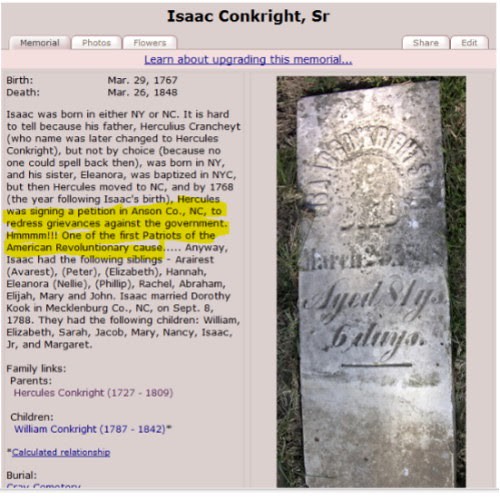
3. Isaac Conkwright was born on March 20, 1767, probably in Mecklenburg County, according to the research of the late Bessie Taul Conkwright. He settled in Washington County, Kentucky, and later Casey County. He died on March 26, 1848, aged 81 years and 6 days, near New Salem, Illinois.
4. Rachel Conkwright was younger than her sister Hannah, and married Richard Oliver’s younger brother, Isaac. This also probably took place in North Carolina. They settled in Clark County. They had nine known children: Nancy, John, Isaac, Elizabeth “Betsy,” Polly, William, James, Joseph Mourning, and Benjamin A. Oliver. Isaac died on October 15, 1835; and Rachel died sometime after that.
5. John Conkwright was born on March 24, 1775, in Mecklenburg County, North Carolina. He married Keturah “Kitty” Lewis in Clark County on January 24, 1799. John and Nancy Vice gave their consent. John and Kitty had eight children. John Jr., Isaac, Frances, Talitha, Elizabeth, Cynthia, Sally, and Nancy.
6. Mary Conkwright married John Jackson in Clark County on August 17, 1795. Hercules posted the surety.
7. Dorothy Conkwright married Aaron Vise in Clark County on January 28, 1807. Averest Conkwright posted the surety.
8. Abraham Conkwright married Nancy Jackson in Clark County on November 27, 1793. Nancy’s father, Jesse Jackson, signed his consent. Their known children were Larkin, John, Nancy, Rebecca, and Benjamin. (Fox Cousins by the Dozens, p. 78).
9. Averest Conkwright.
Hercules land in North Carolina


“Harkless Contrite and Dolly, his wife” of Mecklenburg County sold this land, land in what was to become Cabarrus County in 1792. They probably moved to Kentucky soon after they sold the land, for “Harculus Conkright” appeared on the tax list for Fayette County in 1788. There is no record that Hercules ever owned land in Kentucky, and few records exist on him.
Hercules and his wife died in Clark County on land owned by their son, John Conkwright, and are buried there. Hercules died in 1809, and left no will. The estate was inventoried and appraised.


Picture Taken in 1918.

Isaac Conkright(1767-1848)
3. Isaac Conkwright, son of Hercules, was born on March 20, 1767, probably in Mecklenburg County, according to the research of the late Bessie Taul Conkwright. He settled in Washington County, Kentucky, and later Casey County. He died on March 26, 1848, aged 81 years and 6 days, near New Salem, Illinois.
These were the stomping grounds of Daniel Boone(1734-1820).Isaac married Dorothy Koch (Cook) in Mecklenburg County, North Carolina, on September 8, 1788. Dorothy was the daughter of Nicholas Koch (1720-1799) and Dorothy Barnhardt(1720-1773). Nicholas had come to the United States in 1737 from Germany and settled in Pennsylvania. Dorothy Barnhardt was his second wife and married Nicholas in 1760 to 63. Dorthy Barnhardt came over from St. Johannas, Germany with her brother in 1749. Nicholas’ first wife had died. In the spring of 1764 Nicholas and his family took The Great Wagon Trail south to Mecklenburg, North Carolina where he settled close to the Conkrights.

Koch, Conkright and Landis family took The Great Wagon Road from Pennsylvania to North Carolina, show above in red. The orange rout is the Cumberland trail (Wilderness Road) taken by the Conkrights and Landis families in about 1788.
In 1831 Isaac picked up stakes and moved to New Salem, Pike County, Illinois, with sons Isaac and William. His wife Dorothy had died in 1836.
They had the following children:
1. William
2. Elizabeth (1795-1876)
3. Sarah
4. Jacob
5. Mary
6. Nancy
7. Isaac Jr.
8. Margaret
Elizabeth was born in 1795 in Liberty, Casey County, Kentucky. On February 24, 1811, Casey County Records show Betsey Kinkright, our Elizabeth, marrying Abraham Landess. By 1847 Elizabeth’s mother had died and her father Isaac Conkright was living in Pittsfield, Illinois. Elizabeth and her husband Abraham had moved from Kentucky and were living close to Quincy, Illinois.

Landess Family ( Guenther, 2015 )
In 1847, Elizabeth Conkright Landess, her husband Abraham, and 4 of her sons and 1 daughter left Illinois and set off for Oregon. Her son Henry came a few years later. Isaac Conkright lived nearby in Pike County, Illinois. It must have been difficult for him to see his daughter Elizabeth leave. Isaac died the following year in 1848.
Oregon Story (The Landess Oregon Trail story is written up as a documentary by Don Guenther at the end of this story … The Pittsfield Train)
Illinois to St. Joseph, Missouri
Pre-trip Planning
The Pittsfield, Illinois, wagon train of 1847 set out on April 5 with members from Adams County, Illinois and a couple more families were added in Nebraska. Members of the wagon train were frontiersmen, veterans of the Black Hawk War. These men could fight. They were frontier families; the women were frontier women, understanding the difficulties they would face on the Oregon Trail, well equipped to deal with adversity. Having traveled from eastern states they had wagon train travel experience. They had guides, rough maps and advice on oxen, wagons, food and dress. Hardened to the cold climate they knew to pack plenty of blankets and tents. They also knew how to take care of their animals, their lives depended on the animals.
They brought adult cattle and milk cows. Most of their wagons had three teams of oxen although some had two teams. They knew mules or horses would not hold up pulling wagons over the Rockies.
Packing for a 5 to 6 month’s journey, these seasoned pioneers brought plenty of food. They’d hunt along the way to supplement food supply. The group never experienced hunger. They likely packed lots of vitamin C rich pickles. Fish were purchased from Indians on the trail. Game provided protein.
Wagon Makers
Abraham Landess and his grown son Abraham Jr. were wagon makers. They brought their repair tools and spare parts. Many but not all of the wagons completed the trip to the Dalles. Most wagons on the Oregon Trail were NOT Conestoga wagons; these were slow, heavy freight wagons. Since the train moved fast the wagon train most likely consisted of converted farm wagons, called Prairie Schooners, which were pulled generally by oxen. In fact, oxen were led, there were no reins. Plus, the prairie schooner often had no seat and the pioneers generally walked along the Trail. The ride was too bumpy!
There were no accidental deaths in the Pittsfield train, attributing to the fact that these were experienced wagoneers.
They traveled most of the way in a group of about 25 wagons, which is optimal for protection and grazing cattle. The smaller group was able to travel faster with a quicker set up and breaking of camp. Their water was cleaner from less disturbance and fewer people. Grazing was easier to obtain being the leading group of wagons.
These families were not dependent on store bought clothes and frivolities. They knew how to make do. Living on the frontier meant dressing in “work clothes”. Their work clothes were up to the harsh sagebrush on the trail. Pioneer men wore rugged, durable clothing, constructed from brown, black or gray linen, wool or canvas-like fabric. The trousers fastened with buttons because zippers weren’t widely available until the early 20th century. Many pioneer’s shoes would wear out.
On the trail when a young woman set her bonnet for a young man, that meant she was interested in him. The train members speak of trail courtship. Since when did courtship wait until the end of any trail?
Reason for Taking the Trip
Abraham Landess had 5 grown sons and he wanted a future for them. Four of the sons went west with him, his fifth son Henry would follow.
Waller needed a change of climate to keep him from dying of TB. “Soon, he is told that he must die of consumption. He is no longer able to work much. He had always been a slender, puny lad physically, but now all thought the end had come. Some advised him to go to Texas, others to join the emigration to Oregon. This he did. An ox team and wagon are soon secured, and a bed fixed in the wagon for the sick boy.”[1]
A young Hiram Johnson said: “I confess that I did not think so much about that matter (saving this country for the United States) as I did to bettering my condition in the way of health and to secure a slice of 640 acres of Uncle Sam’s domain for myself and for the future Johnson family, which I must say they did not hang onto very long when they found it took hard work to cultivate and to make a living on the same.” [2]
For some in the wagon train the trip was providence: “William C. Brown had not expected to come to Oregon in 1847, in fact had thought little about it, but early that year he had from Ohio to Missouri to investigate some land in Missouri that he heard could be purchased cheaply. One night when the steam-boat on which he was traveling stopped at a small town named Oregon, Missouri, he went to a store to purchase some tobacco; he heard the shop-keeper talking with a man named Thompson; the store-keeper asked Thompson when he expected to start for Oregon. Thompson replied he would start as soon as he could find a man to drive one of his ox teams. Brown volunteered for the job, and was hired on the spot, and soon was on his way to the West.”[3]
Stewarts: “They came for the same reason that most of the immigrants came from that section of the country – the stories of the wonderful opportunities present in the West.”[20]
Illinois to St. Joseph, Missouri
In 1847 Abraham and his wife and 4 of his sons set out for Oregon. Perhaps they were in search of a milder climate from that of Illinois. Maybe it was the allure of free land. There were hundreds of reasons a person might want to move west.
The Landesses left Quincy, Illinois, on April 7, 1847. Two possible routes at about 230 miles each, at 14 miles a day, get them to St. Joseph, Missouri, around April 21. They may have spent a day or two there but it is more likely that they went right on through when you consider that the entire trip from Quincy to Oregon City was only 5 months and 4 days. Abraham’s wagon mastery no doubt speeded up the trip.
The Oregon Trail 1847(See ‘The Pittsfield Wagon Train’ on Guenther Family History site)
As was typical on the Oregon Trail after 1845 the trail began to develop like a freeway of its day. But moving through South Pass could feel more like ghost hills amidst the mountainous terrain. Wagons would leave one train and join another. There were many river crossings, and so small business entrepreneurs would spring up at many of the crossings to assist travelers across the various locations, and at the same time collect an admirable fee, sometimes up to $5 or more. Soldiers were stationed at multiple forts, starting with Fort Kearney and ending with Fort Vancouver. There was a lot of activity at the forts, which had started up to protect the travelers from Indians and marauders.

Departure Accounts
The main train started in Pittsfield, Pike County, Illinois. The Landess group intercepted them west of the Missouri River as they traveled from a little further north in Illinois.
John Landess with his parents Abraham Landess and Elizabeth Conkright were part of the train. Abraham Landess was born in North Carolina and moved with his parents to Kentucky. Abraham in turn moved to Illinois with his own family and grandparents. In 1846 when Abraham’s four sons decided to migrate to Oregon, Abraham at 58 years of age, and his wife (as grandparents) knew they would take part, making it the final phase of their own migrations.
The train of 71 people and 25 wagons traveled the distance in a record setting 5 months and 2 weeks. The train had no captain. There are many interesting things about these fearless pioneers. They were independent and would become part of the bedrock for the Oregon development. They began as friends, neighbors and church affiliates and after the trip remained friends, neighbors and members of the same church movement. They viewed themselves not simply as opportunists for free land, but missionaries’ spreading their faith and taming the west. Abraham, being illiterate, and Thomas Cowhick left no diaries or trip accounts. To them the trip was just part of life. Fortunately, some of their friends left trip accounts.
The Landess Train
The Landess WagonTrain began as 23 wagons and originated in Pittsfield, Illinois. Records show that the majority of the members were Christians adhering to the Church of Christ. At some point on the trail they combined with the Capps wagon train.
The Following of the Landis family are listed in Stephenie Flora’s and Nancy Prevost’s list of 1847 Oregon Trail travelers(oregonpioneers.com):
16). LANDESS, Abraham Sr.(1789-1855): m’d 1811 CONKWRIGHT, Elizabeth “Betsy”
16) LANDESS, Felix (1820-1903): m’d 1840 WHITE, Elizabeth Jane; s/o Abraham and Betsy (Conkright) Landess
16) LANDESS, George L. (1846-1909): m’d c1874 CARPENTER, Ruhama; s/o Felix and Elizabeth J. (White) Landess
16) LANDESS, John (1823-1904): m’d INGRAM, Leodicia; s/o Abraham and Betsy (Conkright) Landess
16) LANDESS, Mary Jane (1845-1920): m’d 1859 TUCKER, William; d/o Abram and Diana (Decker) Landess
16) LANDESS, Nancy Ellen (1847-1928): m1. 1860 CAMPBELL, John M.; m2. LOGAN, Thomas; d/o Abram and Diana (Decker) Landess; born 13 June 1847 on the plains
16) LANDESS, William (1833-1895): m’d 1853 GRAHAM, Elizabeth Caroline; s/o Abraham and Betsy (Conkright) Landess
The Ship of the Desert
Hiram Johnson: “We left Pittsfield, Ill., April 5, 1847, with three yoke of oxen and wagons in company with about twenty other wagons. I drove that team every day myself.” [2]
Waller: ”Among those who set sail in the “Ship of the Desert” were the following families: Father Landess, Felix Landess, Abram Landess, — Scholl, Sam Whitely, H.A. Johnson, Nathan Richardson, H.M. Waller and G.T. Waller. There was also a bachelor wagon with John Richie, James Richie, Thomas Humphrey and Frank Barrow.”[1]
The men in the bachelor wagon had jobs such as wagon drivers, cow hands, hunters, protection and cooks.
Waller: “To one whose love of home is great and who loves the association of early life, it is no easy task to fold up tent and ride away to a wild and distant land. But now comes ‘goodbye’ to old friends, and while ‘tears do unbidden start,’ the oxen, with their slow tread, begin their long, weary journey.”[1]
Lewelling’s Wagon Odometer
( http://www.oregonpioneers.com/BonserFamily.htm )
The Oregon Trail was about 2200 miles long. There is a historical account that specifically mentions an odometer on a covered wagon owned by Iowa nurseryman Henderson Lewelling, who brought 700 fruit trees to Oregon in 1847. Lewelling was on the Landess train. The odometer was made of wood and attached to the wagon wheel axle, counting the number of turns per mile. With an odometer water holes could be marked and graves on the trail could be recorded. It is not known if Lewelling had access to these types of markings. But at the least they would know if they traveled the 12-15 miles a day required to get them through the mountains on time.

Crossing The Missouri River from St. Joseph, May 1st
The Landess group crossed the Missouri River on May 1 for about $30 a wagon, a month’s wage. The ferries were expensive but necessary at dangerous crossings. Rivers could be deadly even when not at flood stage. Kansas was gently rolling hills and travel wasrelatively easy. Sometimes they would have to break out the shovels to get through creek beds that had cut deep.
Their train included much livestock for the Oregon venture. Now they just had to get them through, keep them fed. The wagons were hitched to three teams of oxen for more speed and pulling power. Abraham Landess was not only a wagon maker but would have known the rigors of the trail, the necessity of well built wagons and experienced teams.
For three or four weeks west of the Missouri River the low hills and copse of trees made for pleasant travel. The wind, however, was pervasive and even uncomfortable, blowing morning to night. A fierce wind in the early spring was often biting cold. By May both the wind and cold would have abated. There was still rain and mud to deal with.
![35521fe8-6489-450a-ac06-21273ae399fd[1]](https://live.staticflickr.com/65535/49659000931_c2dd1df6cb_c.jpg)
Landess’ Trek on the Oregon Trail, 1847
“They (Felix Landess and wife) made the journey across the plains with ox teams in 1847, traveling after the primitive manner of the times in a train composed of twenty-five wagons. The parents of Mr. Landess were also of the party and they completed the trip in five months, this being considered a very speedy trip for those days. The roads were often in very poor condition, streams had to be forded and at night the party camped out along the wayside, building fires and preparing their food. It was often difficult to secure a good place to pasture the stock and to obtain fresh water. Yet without serious mishap the party continued on their way”. [5][6]
Kansas: The Wagon Train Crossed the Big Blue River on May 9th
They crossed the Big Blue River on May 9th, The plains travel being relatively easy.
Nebraska
In Nebraska they may have purchased supplies at Fort Kearny. They traveled along the Platte River valley, a good course mostly but the water was thick and not desirable for drinking. Starting in 1849 the polluted waters of the Platte brought epidemics of cholera to the wagon trains. They sought to get water from the creeks coming into the river. Mud was an issue, bogging down the heavy wagons.
Through Nebraska and Wyoming rains, wind, and lightning were frequent in the spring when they traveled. The mud got worse. Grass was good and reported to be so high in this area that when a man walked you could only see his hat. The bison were roaming the prairies by the hundreds of thousands, providing meat and jerky to diminished supplies. Fires were stoked by buffalo chips, but it took a huge amount to provide a fire to cook with .
Platte River
The Landess train crossed the Platte by ferry on May 29th and arrived at Fort Laramie in Wyoming on June 4, 1847. When they arrived at Fort Laramie, the soldiers warned them of danger, both from Mormons and Indians. But coming down into the Platte River on May 29, the country presented a different spectacle, land, flat land as far as the eye could see. Where were the trees? Was it the Indians burning the prairie every year that robbed the land of its covering? Surprisingly, though, the prairie was not as flat as it looked when actually traveling on it. The travelers at this point did not have privacy bushes or trees, some of the women keeping chamber pots in their wagons, others using a wall of women for privacy. This kind of unsanitary condition no doubt contributed to sickness and disease, especially for the wagon trains getting a late start. Rains would wash some of the debris into the river. Add to that the muddy Platte River, and it was hard to keep from exposure to bad bacteria and generally bad water.

Platte River
Year by year the Oregon Trail underwent improvements, new bridges, improved roads, shortcuts or cut-offs. In 1847, though, the trail was relatively young. It was important to have seasoned guides and captains.
To get a good feel for the Oregon Trail a must read is A.B. Guthrie Jr.’s The Way West, a Pulitzer Prize winner in 1950. Guthrie was born in 1901 and lived alongside some of the old timers who had traveled the trail. Guthrie outlines reasons why people went west: good hunting, rich soil, mild climate, lots of water power, save America from the Brits, the Ocean for marketing, a new start, a chance to make history, make a man feel like something, and the list goes on from there.
There was a bushel of dust to swallow on the way and mud to slosh through, heat to contend with, and disease and sickness, rain and cold, mountains and rivers to cross, and the glory of it all!

Along with everything else on the list of things to bring for the trip, you could be sure there was a dutch oven in the wagon! And Indians loved to eat mules, another reason why oxen were preferred.
Oxen may be slower, but they could get you over tough spots better than mules. Mules could be obstinate. And oxen were less picky about their food. Plus, oxen were stronger for heavy loads, trudging up hills, and dragging wagons out of mud holes. It was recommended to have three pairs of oxen to pull a large wagon.
Abraham Landess was more than capable when dealing with broken axles or wheels, not to mention the rigging. He was 58 years old, considered old in that day, but he had spunk. He would do. And you can be sure that the Landess wagons kept well greased axles.
Three Orphans
Abraham and Elizabeth had a daughter, Mary. Mary Landers, born in 1812, married Mr. Taylor in Casey County, Kentucky. They had two children, Simon and Elizabeth, in Kentucky. The family moved with the Abraham Landers family to Illinois in 1838 where they had Nancy. They had 3 children: Simon P.(1834-1873), Elizabeth Ann(1836-1875), and Nancy(1838-1882). It appears that Mary and her husband both died prior to 1847, because the 3 children are on the Oregon Trail with the Landess’ train but their parents are not. The family took the children in, as was expected in that day. It was family, and the Landess family stuck together.
Also on the train was a bachelor’s wagon. In this wagon traveled a Thomas Humphrey(1822-1898). At about age 14 Elizabeth Ann married Thomas in about 1851. They had 10 children in the Hillsboro area. Simon married Louisa Liggington(1844-1934) around 1860 and they had 5 children in the Hillsboro area. Nancy married Lindsay Littleton(1829-1913) and they had 2 children.
The Landess family brought these 3 children with them on the Oregon Trail. Usually the trip took about 6 months but their wagon train made it in 5 months. Grandpa Abraham was a wagon maker and most likely made the wagons. Remember they had a sick minister with TB in one of the wagons too. Abraham was watching over a lot people on the trip. It is believed Abraham contracted TB while caring for an ailing minister on the Oregon Trail. This would explain his death 7 years later. The Landess’ train may have been a whole church going west, sick minister and all.Simon was 13 years old heading up his own wagon with his 2 little sisters. He was a young man at age 13. In Oregon the children lived with Abraham and Elizabeth, and then after Abraham’s death, Simon and Nancy lived with Abraham’s son John Landess. Simon eventually took up his own land claim. He became a farmer in Hillsboro, Oregon, living close to the Landess families.
Fort Laramie June 4th
The train moved down the Platte River country to Fort Laramie, arriving there on June 4. Fort Laramie was a key point on the Oregon Trail in the sense that it marked a take off into the Rockies. After that came desert, then Oregon country. Indians staying around the fort would look for trade with the pioneers, their drums sounding at night like a wilderness cry.
![ea631af6-391b-4ad3-a877-dbd70db5e711[1]](https://live.staticflickr.com/65535/49659248592_8130821e4c.jpg)
Crossing the North Platte River, June 16
They headed west and soon crossed the North Platte River. The group displayed no fear. Indians and Mormons left them alone. Seasoned fighters in the group paid off; and they were armed. The word may have gotten around. You can be sure rifles were in sight.
Wyoming
Independence Rock
From Fort Laramie, having restocked and attended to wagon repairs, they moved toward a giant monolith of granite called Independence Rock. Rattlesnake country. Add that to potential deadly elements, which also included death by exhaustion or injury. This marked the way into the Rocky Mountains and South Pass. This was a lonely country and the pioneers had to be equipped to fend for themselves.

The terrain got steadily rougher, jagged mountains began to appear. Some trains reported seeing millions of buffalo, and they were a threat in themselves when in great numbers. A stampede could wipe out a train in minutes. Just browsing buffalo could overwhelm a campsite with their sheer weight and power. Where the buffalo were it was certain wolves would be following, taking down the weak of the herd. The bellowing of them could be heard for great distances.
Along the trail could be seen the litter of previous trains, lightening their load, leaving cookstoves, pianoes, and heavy furniture.
Following the Sweetwater River Valley, the Landess train moved toward South Pass in the Rockies. Fort Bridger was established in 1844 to outfit the growing number of wagon trains. The Landess train would have come to this outpost about the end of June. Supplies were expensive but there were no shopping malls around. Somewhere after Fort Laramie they crossed into the land of the Sioux and Pawnees. One day, while eating dinner, a band of the Sioux, numbering 800 warriors blocked the trail. Hiram Waller records in his journal that they intimidated the Indians by firing a pistil repeatedly. This is detailed in Hiram’s journal below.
They crossed the Sweetwater 9 times before coming to the Continental Divide at South Pass.
Hiram Johnson: “We made it a point to keep in the lead of the immigration, thus always sure of good grass, water, etc. We had made it a point to never camp twice at the same place except at the crossing of a line. By this means and by using energy we kept in the lead.” Weekly Statesman Journal, June 7, 1895, Pioneer Life on the Plains
In Hiram’s account there were no difficulties with the Indians worth mentioning.
Green River July 4th
Reported from an adjacent train to theirs on July 1st: “Doctor Smith was seized with his last illness. By the time they reached Green River they left his mound of up-turned earth to mark their pathway, and the bereaved family went the remainder of the journey.” [9]
Hiram Johnson: “On the Green River one of my oxen got poisoned and we of course had to leave him, but a little matter like this did but stop us long for in the morning I yoked up one of my cows in his place and came ahead. So old White-faced not only helped to pull the load but she gave milk for the babies and we had a fine time”[2]
Hiram speaks lovingly about his animals. They were a part of the family. He regretted having to leave one behind. Two years earlier Abner Hackleman made this comment at about 1,000 miles into their trip; “Our wagons are now undergoing repairs, having become shrunk almost beyond your conception by protracted and excessive heat from the sun and sand.”
Abraham Landess Sr. and Jr. were wagon makers. Their skills came in very handy in keeping the wagons functional. Typically wagon trains would stop for several days to make wagon repairs. Hiram Johnson notes that they made no such stops.
Crossing rivers in the spring was dangerous. Hiram Johnson speaks of tying ropes to the rafted wagons.
South Pass
When the wind blew it carried sand. Sand was in everything. They moved along the Sweetwater River, staying close to known water whenever possible. There was the Green River, and then the Bear. Without water the train was doomed, so the trail wound along with a river alongside typically. Foraging for the oxen and cattle and horses grew sparse. It was critical to keep the animals fed and strong, but at times that proved impossible and the wear on the animals could be seen and felt.
Fort Bridger
Fort Bridger was remote, well into the Rockies. Perhaps that was why it had a reputation of being dirty and unkempt. That and the lack of women in this barren location. Just the same, it offered a restocking of necessary supplies. It was a favorite hangout of mountain men. Traveling through the Rockies meant steep places, and ropes were required. The weakened oxen could not always bear the load. Forage for their animals got scarcer and scarcer.
![e055fadf01e6d654f8f93c90ba70302b--oregon-trail-gold-rush[1]](https://live.staticflickr.com/65535/49243628101_5d3cae313a.jpg)
Fort Hall August 1st

They arrived at Fort Hall on August 1st. Supplies could be had there.
Just past Fort Hall the California trail splits off. The wagon train did not split as all the members were intent on going to the rich soil and mild climate with lots of rain Oregon. In the 1849 gold rush many of the men from the wagon train went to California to work the mines or related industries. Nathan English died there but most returned having made good money.
Benjamin Stewart’s wife gave birth to Orville in Aug. 1847 near present Pendleton on the Trail.
Law on the Oregon Trail
Many people, often strangers, were required to live together for 5 or 6 months. Disputes could rise up in a moment over any number of things. Maybe there was disagreement over a river crossing, or who owned what cattle or possessions, how to treat the sick, over women, concerning the pecking order of the train, or any host of potential problems. There was ‘no law west of the pecos’, or in this case west of Independence, Missouri. But actually, the wagon trains constituted their own laws, laws mostly grounded in common sense decency. It was pretty much ‘root, hog, or die’ as the cliche of the day declared. It is thought that the Landess train were people of like mind and did not have to deal with many of these issues. Just the same, they would have encountered other trains dealing with these issues, perhaps even having come across a hanging or execution.

Not everyone on most trains shared the same religion or the same moral code. These were people from all over the place. Imagine being camped with a large group, maybe 2-300 of them total strangers. Protecting daughters was a priority. A man had to look out for his own because it wasn’t happening that any sheriff would show up. The Landess train was made up of Christians, mainly The Church of Christ, and this accounted for much of their success.
If a man was found guilty of a serious crime there was no appeal, only the nearest tree for a hanging. If there were no trees then scaffolding was arranged. The man ended up in a shallow grave as the train moved on without looking back. It is estimated that 172 murders occurred along the trail, murders by fellow travelers. Murders over women, robberies, and money. Violent murders with guns and knives. Rape likely resulted in hanging.
“It is true that no general organization for law and order was affected on the western side of the river. But the American instinct for fair play and a hearing for everybody prevailed so that while there was no mob law, the law of self-preservation asserted itself, and the counsels of the level-headed older men prevailed. When an occasion called for action, a “high court” was convened, and woe betide the man that would undertake to defy its mandates after its deliberations were made public.” – Ezra Meeker, recalling 1852
“If there is any meanness in a man, it makes no difference how well he has it covered, the plains is the place that will bring it out.” – E. W. Conyers, 1852
“For minor crimes, the council would generally order only mediation. More violent crimes might include a public whipping. Serious crimes such as murder, rape, and theft of horses, were addressed more formally with the emigrants choosing a judge, forming a jury, and holding a trial to the standards they were familiar with. Punishments for these serious offenses included banishment from the wagon train, hanging, and firing squad.”
Idaho
Coming into Idaho they encountered Big Hill. Getting up was one thing, requiring double teams, but the descent was a nightmare. Block and tackle was the safest approach… if you had the apparatus. It is suspected that the well planned trip by the Landesses had it covered. It was August and the weather was stifling hot. The deceptively dangerous winding Snake River would be crossed a couple of times, probably floating their wagons.
Coming into Idaho they encountered Big Hill. Getting up was one thing, requiring double teams, but the descent was a nightmare. Block and tackle was the safest approach… if you had the apparatus. It is suspected that the well planned trip by the Landesses had it covered. It was August and the weather was stiflingly hot. The deceptively dangerous winding Snake River would be crossed a couple of times, probably floating their wagons. They found supplies at Fort Hall, established in 1836.

Benjamin Stewart’s wife gave birth to Orville in Aug. 1847 near present Pendleton on the Trail.
The Snake River
Going down the west side of the mountains brought them to the Snake River, cutting through deep canyons and twisting and turning through the rugged terrain. Sometimes the trail would eyebrow across the side of a hill with an acute slant to the road itself. Men may have to walk on the upward side of the wagon to keep the wagon from tipping over. If the wagon was not in good shape it could buckle under the stress. Again, it is believed that Landess wagons were kept in top shape. The Snake was black and cold and difficult to ford.
Crossing the Snake for the last time they came to Fort Boise.

The Blue Mountains
Coming across Idaho and into present day Oregon presented the wonderful sight of the Blue Mountains. It etched into the mind of the pioneers the promise of Oregon. On the other side lay the mighty Columbia River.
The Dalles September 1st
The train arrived at the Dalles on September 4th. From here they split into two groups, one group rafting the Columbia, and the other larger group taking the newly established Barlow Trail. The Barlow Trail was a big improvement from having to take cattle over Lola Pass, a very steep and crooked mountain pass. Those with cattle took the Barlow Road, this including the Landess families and Hiram Johnson.
The Columbia River
The Columbia River marked the end of the wagon trail until 1846 when the Barlow Road was established. The Landesses were able to keep their train intact as they made this final and difficult trek. Previously, trains had hired out the rafting of their wagons down the Columbia while the pioneers herded their cattle over Lola Pass, a steep and winding undertaking that was very difficult. Not that the Barlow Trail was easy, it was not, being steep and difficult, but in comparison to Lola Pass, it was a big improvement. The Barlow Trail connected travelers to Oregon City from The Dalles.
The Barlow Road
“The eighty-mile(80-130 miles) Barlow Road began at The Dalles, running south through Dufur to the Tygh Valley, where it veered west across Tygh, Rock, and Gate Creeks. The road then crossed the White River before ascending northwest along Barlow Creek. It skirted the south side of Barlow Butte, heading west past Summit Meadows and Government Camp to descend the steep Laurel Hill. From there, the road continued north and west, following Camp Creek to the Sandy River, where it crossed to the north bank. It passed Rock Corral en route to Marmot, where the road then followed the Devil’s Backbone southwest back across the Sandy River. After crossing Eagle Creek near Foster’s Place and the Clackamas River at Feldheimer’s Ford, the road passed through Logan and then ventured northwest to terminate at Oregon City.” The Oregon Historical Society, ‘The Oregon Encyclopedia’.
The Provisional Government permitted Barlow to charge $5 a wagon and 10¢ a head for livestock to use the Road. Barlow received financial backing from a man named Philip Foster, employed 40 men, and Barlow hacked out a narrow road of about 100 miles through forests, rivers, and marshy meadows from The Dalles to Oregon City. The Dalles History, http://historicthedalles.org/history/

Figure At The Dalles, Oregon, the train split into three groups.
![unnamed[2]](https://live.staticflickr.com/65535/49672817396_33a0a1a7e7_c.jpg)
They arrived at Oregon City, Oregon, on the ninth of September, 1847. The whole trip from Quincy to Oregon City was about 5 months, good time. Abraham’s wagon mastery no doubt speeded up the trip. To top it off, it is believed that they did not travel on Sundays. If so, they would have had to average 15 miles a day.
Hiram Johnson:”I had not money when I started to this country, did not need any, had no ferriage or tolls to pay (Oh, yes my wife did give up one of her fine quilts to pay toll at the Barlow gate.”[2]

Hiram Johnson: “We arrived at the Dalles about the first of September. We then came through the Cascades by the Barlow road. This road was a little rough for sometimes down those steep hills we had to cut down small trees and chain them to the hind end of our wagons to keep them from ending over onto the oxen, but not hurt anything. We got through all right, arriving at Oregon City September 10th.
Oregon City, September 10th
The Barlow Road group arrived in Oregon City on September 10th. They had ended their journey.
Hiram Johnson; “Then again we hear so many tell of the great hardships and privations they underwent in crossing the plains and their first settlement in this country. As far as I’m concerned we had a nice time and pleasant trip.” [2]
Those in the wagon train that rafted down the Columbia River took longer to get to Oregon City as they had to wait for rafts to be made.
The Stewarts stayed a short time at Whitman’s mission and left before the trouble with the Indians occured.
![9703065f-a199-447b-921a-10475618622f[1]](https://live.staticflickr.com/65535/49658928631_58985a4712.jpg)
End of the Trail in Oregon City
Oregon City was mostly considered the End of the Trail, at least for those coming to the Willamette Valley. It was here the pioneers put in for land claims. They had to be quick, with wet and cold Oregon weather at hand. If they could get to their claim they could erect a simple log structure to get by in until they could build a permanent house. The first winter was rough, but at least they were off the infernal Oregon Trail!
Looking Back
This was an unusual train. Possible reasons for why the Indians left this group alone included: The Indians recognized this group consisted of seasoned frontiersmen experienced in fighting Indians; they were armed and dressed in western clothing, many of the men had fought in the Black Hawk War and in The War of 1812; being the first wagon train they may have gotten through prior to the Indians being ready or aware of the wagon trains coming; just prior to their arrival at The Dalles their had been an altercation and an Indian chief had been killed, possibly subduing the Indians in transition to finding a new leader; this train was experienced and knew how to get along with the Indians and not provoke trouble; this group was mostly Christians and God was protecting them; they were well provisioned and didn’t trade with the Indians or need to purchase goods, making less exposure; having been well provisioned they didn’t compete much for game; they moved quickly and kept the Indians off guard; they rarely stayed in one spot for two nights.
Oregon
Abraham took up a donation land claim near Scholls, DLC #635. It was located on the Tualatin River, a major crossing site at the time. He was among the first to settle this area. It looked good, with river access for shipping crops, but it played out, becoming something of a ghost town over time. There were many such places in the west of this period.


They attended the Farmington Christian Church. As a family, the Landesses were Christian leaders of their time. Their Christian beliefs were forefront in their dealings with their neighbors. It may have been their Christian convictions that brought them to Oregon, like the Pilgrims on the Mayflower.

Death of Abraham Landess
![9d8a2024-6b73-4afe-910e-9222a2a89f0f[1]](https://live.staticflickr.com/65535/49659215942_599034b792_m.jpg)

Abraham and Elizabeth had 10 children:
1. Mary(1812- ) was born in Casey County, Kentucky. She married a man named Taylor. They had three children.
2. Patsy(1814- ) was born in 1814 in Casey County, Kentucky. She died in about 1845 in Adams County, Illinois. She married Jesse Evans and they had 5 children: Thomas(1834- ), Catharin(1836- ), Joseph(1839- ), Elizabeth(1840- ), and John(1845- ).
3. Henry(1816-1891) was born in 1816 in Casey County, Kentucky, and died in 1891 in Portland, Oregon. He married Mary Jane Richardson(1822-1882) in 1842. They had 3 children: Frances(1845-1932), William(1849-1933), and Richard(1854-1936). Henry came to Oregon on the Oregon Trail in 1852, following the family call.

4. Joseph(1818- ) was born in Casey County, Kentucky.
5. Felix(1820-1903) was born in 1820 in Casey County, Kentucky. He died in 1903 in Washington County, Oregon. He married Elizabeth Jane White. They had 2 children: George(1847-1909), and Louise(1849-1927).
5. Felix Landess(1820-1903) married Elizabeth Jane White(1822-1914) in 1839. They had two children: George Landess(1846-1909); Louise Landess(1849-1927).


6. John(1823-1904).
7. Abraham(1825-1854) was born in 1825 in Casey County, Kentucky and died in 1854 in Washington County, Oregon. He married Diann Decker(1824-1882). They had 5 children: Mary Jane(1845-1920), Nancy Ellen(Elinor)(1847-1928), Adeline(1849-1922), Martha Ann(1851-1943), George(1854-1918).
8.Elizabeth(1827- ) was born in 1827 in Casey County, Kentucky. She married Jesse Evans and they had 5 children: Alvin(1848- ), Mary(1849- ), Adeline(1854- ), George(1856- ), and James(1858- ). In Liberty, Casey County, Kentucky, Patsy Landers, born in 1814, married Jesse Evans. They had two children there in Kentucky and moved with her parents family to Adams County, Illinois in 1838. They farmed there and had 3 more children together. Patsy Landers died around 1845, leaving her husband Jesse Evans with 5 young children. Jesse needed help and the Abraham family stepped up. Jesse’s family needed a full time mother. Patsy’s little sister Elizabeth, born in 1827, married the widower Jesse Evans. Elizabeth and Jesse had 5 children. When the Abraham Landers family migrated to Oregon Jesse Evans and Elizabeth stayed behind in Illinois.
9. Isaac(1830- ) was born in 1830 in Casey County, Kentucky.

10. William(1833-1895) was born in 1833 in Casey County, Kentucky, and died in 1895 in Washington County, Oregon. he married Elizabeth Caroline Graham(1837- 1884), the daughter of Sarah Sally Winn Graham Ingram. They had 8 children: Mary(1856- 1935), Abraham Lincoln(1857-1863), Sarah E.(1860-1862), George Lincoln(1863-1922), Cora M.(1866-1873), the death of an infant son in 1867, the death of an infant son in 1868, and the death of an infant son in 1870.
John Landess(1823-1904)


John was born in Casey County, Kentucky, in 1823. When his father and 3 of his brothers went west in 1847 he went with them. John was a farmer and he took about 300 acres near Scholls in a Donation Land Claim, an area that became known as Farmington.
California Gold Rush of ‘49
Just east of San Francisco, in a place called Coloma, a man by the name of James W. Marshall found gold on January 24, 1848, at Sutter’s Mill. John Sutter was a settler with an extensive estate who ran a saw mill. With the gold rush his land was basically overrun and confiscated and he lost it all. The California gold rush was a major event in American history and resulted in America owning California by right of population.
Tens of thousands of people poured in over the next few years, 81,000 in 1849 alone. One of them was John Landess. He was 26 and single, and looking for the big strike. John was a 49er.
Peter Scholl, a neighbor to the Landesses and also guardian for the three orphans of the Landess family, Mary Landess’s children, is recorded as going to the gold fields in February of 1849 by means of a ship out of the Columbia River. It seems likely that John went with him, although the cost of travel by ship was expensive.
Nathan English, a friend of John’s and fellow traveler on the Oregon Trail, having taken a claim in Yamhill County, is recorded as having gone to the California gold fields in the fall of 1849, presumably by the Siskiyou Pass. It is possible John went with him.
The California gold fields of ’49 were no place for cowards or weaklings. It was a rough place with a lot of rough men. The women? It is true that some of the men brought their wives and family with them. There was the usual crime accompanied with the gold: theft, murder, cheating, debauchery. Vigilante groups formed to deal out justice quickly and oftentimes severely. Even men who appeared suspicious could be run out. Basically, no police.
As might be expected, with so many gathered in one location with little sanitation, sickness and disease were prevalent and many died. Some of the culprits were typhoid, measles, malaria, small pox, whooping cough and tuberculosis. Scarlet fever and cholera were probably the worst.The work was brutal. For the most part, the ones who got rich were the businessmen and women. The California Trail was hopping with gold seekers.
In a letter by Peter Scholl to Pastor J. Ellidge, Scholl declares that Nathan English was part of a group of Oregonians who were massacred by Indians at the gold fields in 1849. There were six men at the mining site. Two were gone when the massacre took place. Nathan and three others were killed and burned. Over twenty Indians were killed in retribution by a vigilante group, (Letter from Scholl to Ellidge, September 5, 1849, posted by Christopher Durall, 2003). It is not known if John was part of this group.
For many of the men it was a place of loneliness and little to no financial return for their efforts. What little return they got was spent on the high cost of living. After 11 months John threw in the towel. As for getting rich there, any gold he brought back has not yet been discovered in the family treasury. On the other hand, he may have grubbed out a stake and headed home. It is thought that the death of his friend may have influenced his decision to return to Oregon after such a short stay.
John Takes in Mother and Niece
When John’s brother Abraham died in 1854 and his father in 1855 Elizabeth stayed with John and they raised Abraham Jr.’s daughter Nancy. When John married Disa, Elizabeth moved in with William. None of the daughters came west and it may be that Elizabeth felt close to her youngest son William. Or it may have been that Leodicia wanted to give the newly wedded John some breathing room. This was a very caring family. They took care of one another. This is seen again when John and Disa took in granddaughter Wilda. The Landess family had a view that their family included all their brothers and sisters and their children. They were an inclusive family.
John Marries Leodicia Ingram
It was no surprise when John married a neighboring farmer’s daughter, Leodicia Ingram, on December 14,1862. John was 39, Leodicia 15 in the year 1862. John finally found his gold mine in a slip of a girl. Leodicia had come on the Oregon Trail as a little girl of age 5 in 1852. Women were scarce and John was lucky to find her. John already had his farm, he just needed a wife to fill in the blanks of his life. It is believed that he married her for love. Disa had had farming in her blood and was a loving, giving person. John was of like nature. John’s brother William had married Leodicia’s half sister Elizabeth Graham, daughter of Sarah Sally Winn-Graham-Ingram. The years separating their ages made little difference, as over time John and Disa were deeply committed to one another. Leodicia’s deep faith carried the family through difficulties of various types: death, sickness, and hard work. She was stable like a rock.

John and Disa Landess with son Grant. Taken about 1870.Washington County Museum, Portland, Oregon

John and Disa’s Children
John and Leodicia had 7 children:
1. Ulysses S. G.(1864-1943): Ulysses, or Grant as he was called, married Mary Hinton around 1890. They had a baby son who died as an infant in 1892, and Esther(1893-1939).


2. Ruhama Hattie(1865-1920): Ruhama married Walter Posser(1862-1941) in 1885 at age 20. They had 4 children: Homer E. Prosser(1886-1901), Fred Prosser(1888-1918), an infant daughter(1890-1890), and Helen B. Prosser(1896-1976). Fred died in World War I in France at age 20. Ruhama died two years later in 1920, some say of grief for the life her son never lived.
3. Elmer Elsworth(1869 – 1872)
4. Corena Maylona(1873-1931)
5. Marietta(1876-1943): Marietta Landess married George W. Washington about 1892 and they had 3 children: George W. Washington(1893-1945), Hugh E. Washington(1895-1956), and Marguerite Washington(1898-1933).


6. Girtha Ellen(1885-1961): Aunt Girthy’s house was open to the family. She married Carl Larsen(1879-1941), but had no children. Ronald Guenther tells this story of a memory: Aunt Girthy had a piece of property behind her house and there was a small shack on it. They constantly took in down and out men hoping for an inheritance but one never came. But one of those old fellows was named Jim. Well, old Jim died but he told them he would make contact from beyond the grave. And sure enough he did. They could hear knocks in the wall and they asked questions. Well, one day Grandma Wilda stopped by to see them just when this kind of thing was going on and they told her that this was the ghost of old Jim. Grandma said that she was extremely frightened but she still had presence of mind and she screamed, “Who are you, declare thy self.” The knocking stopped and never came back. The aunts were furious. Grandma was proud of herself. Mom said what they heard was rats, but one has to wonder!
Aunt Girthy housed almost the entire family of Geraldine Guenther one time. But horror of horrors, she showed slides of Europe all night. She could make pancakes all right.
7. Mamie(1887-1968): Mamie married Oliver Brand in 1906, but things didn’t work out so good for them. Then she married James A. Shaw(1874-1937). Mamie had no children and outlived all of her siblings, dying at the ripe old age of 81.

John Landess’ Death

Corena Maylona Landess(1873-1931)

Corena Landess was born to John Landess and Leodisa Ingram Landess on June 5, 1873, in Hillsboro, Oregon. Corena married Wilbur D. Wiley(1856 – 1909) in 1889 when she was 16 and pregnant, Wilbur 33. Certainly an acceptable age for this day, but Rena was just a girl, perhaps not prepared for the trials that awaited her. Rena came from a Christian family who did daily Bible readings, Wilbur from a rough frontier family. Day and night. Perhaps they were doomed to failure in their marriage. Maybe Wilbur was a little too connected to the old western saloon life that his father and brother ran. In 1909 Wilbur stepped in front of a train, bringing an untimely end to his unhappy life.
Baby Virgil Dies
Corena was a sensitive woman, writing her thoughts into poetry. They had three children: George M. Wiley, Wilda R. Wiley, and Dora A. Wiley. But then with their fourth, Virgil in 1895, tragedy struck and the baby died on October 18 of that year, only two months old. After losing a baby son her first marriage failed, Rena and Wilbur separating after the baby’s death. It is thought that their marriage was already failing and in the divorce Rena was given custody of the children. Wilbur was not able to meet the needs of Rena.
![image03[1][1]](https://live.staticflickr.com/65535/49615160986_3cba899e69_m.jpg)

Corena Maylona Landess married August Banhart Stahl in Multnomah, Oregon, in 1899 when she was 26 years old, less than a year after her divorce. No doubt a hasty move. She worked in his shop. It is thought that Stahl did not do well in business, as reflected in frequent moves.Rena’s children suffered as she traveled around with her second husband, a tailor.
![unnamed[2]](https://live.staticflickr.com/65535/49615061098_0b060f6253_c.jpg)
Wilda remained with her grandmother, Leodicia, who raised Wilda as her own. The census of 1900 shows Wilda living with her grandparents. But by age 12, Wilda’s grandparents had both died.
When Wilda was a teenager Rena sought to gain custody of her, but Wilbur and blocked the effort and got her enrolled in a Catholic school. At age 14, Wilda chose Wilbur over Rena.
Again, when Wilda was 17, Rena tried for custody, but Wilda successfully petitioned the courts to have Wilbur’s brother William Wiley appointed as guardian. William owned a saloon and at some point Wilda became a drinker. Would Rena have been the better choice?
In 1927 Wilda lost her own14 year old daughter Louise to polio, and found solace with her mother Rena. Wilda struggled in her own marriage as well, giving her and her mother Rena another connection.
Wilbur and Rena had three children: George, Wilda, and Dora. They all experienced difficulties in their lives. George did find love in a wife before he died. Dora may have never found her love with the exception being her son, Edwin Doyle. Edwin was a favorite with Geraldine Clara Delsman, and Geraldine overlooked his drinking. Edwin was very happy to have Geraldine, a cousin, to connect him to the larger family, and he did much research into family records.
Corena’s Poetry
Great Grandmother Corena was noted for her beautiful poetry. Here is one of her poems, written in 1920, The Book My Mother Read, reflecting on her mother Leodisa’s favorite book, the Bible. The poem seems to emanate from Rena having found peace with God, and it honors her godly mother, Leodicia.
The Book My Mother Read
I have it yet the dear old book, That lay upon the stand
In which she often used to look, And always at her hand;
The corners rounded are with age, The leaves are worn and thin,
And dim the lines on many a page, She so delighted in.
A half hour rest in household toil, For needed strength she caught
And in the light of fragrant oil, She found the place she sought,
And heavy labor turned to love, And duty led away
To visions of the land above, A Sabbath hour each day.
The Book remains more sacred still, Because of her dear eyes,
That saw there God’s wondrous will, And seen not otherwise;
For thus she found a way to him, Who down to evening late,
And through the valley, lone and dim, Brought her to His dear gate.
Corena wrote They Took Papa Away in 1924, reflecting back on the death of her father, John Landess, in 1904. Her poems reflect her deep love and respect for her parents:
They Took Papa Away
Some 20 years ago today, They took our papa away
Never more his smile to see, Yet he’s ever dear to me
Gone to that far distant shore, Where we’ll see him never more
How we need to sit and watch him, As he sat beside the fire
He would sleep and dream of childhood, Then he’d wake with a smile
Rena’s Death
Rena had two children with Stahl, but both died. She stayed with August Stahl until her death in 1931. Rena and August appear to have had a good marriage.
Rena might have laid by Wilbur’s side in death but instead there is an empty grave.
The Empty Grave

Rena’s Grave
It is believed that Rena lies in her grave at the Lewis Pioneer Cemetery in Hillsboro, Oregon, next to her baby Virgil. Next to Rena would be August. The graves have been vandalized so not all of them are readable, but common sense deduction leaves little doubt as to the occupants of the Landess graves. The graves tell Rena’s story.
![unnamed[5]](https://live.staticflickr.com/65535/49611723851_d6ca1fec21_c.jpg)
Wilda Ruth Wiley(1891-1960)
Wilda Wiley married Joe Delsman(1887-1940) in 1910. They had Louise(1913-1927), Geraldine Clara, and Richard(1917-1943).
Wilda’s Grave
After Joe died, Wilda, now calling herself Irene, likely a message showing a connection with her mother Corena, married Frederick A.Meier(1904-1966) in 1947. Fred was 13 years younger than Wilda. When Wilda died in 1960 Fred buried her and then he in turn got remarried to Ruth Eloma Bennett in 1961, not letting any grass grow under his feet. Then Fred died in 1966 and Ruth had him buried next to Wilda in a prepaid grave. Finally, Ruth died and was buried on top of Fred. This was a bit shocking to some of the family.


Wilda’s(Irene) Grave Side by Side with Fred’s and Ruth’s Grave
Willamette National Cemetery, Portland, Oregon; photo by Don Guenther
There was another family grievance against Fred. He was supposed to keep up a $10,000 life insurance for Geraldine as her inheritance, since Fred spent the rest of it himself. It didn’t happen. Wilda struck out.
Geraldine Clara Delsman(1916-2012)
Geraldine married John Emmel Guenther(1912 – 1991) in 1935. They had the 14.
.
Bibliography
Flora, Stephenie, and Prevost, Nancy; Emigrants to Oregon in 1847; oregonpioneers.com
Guthrie, A.B. Jr., The Way West, 1949, Copyright by A.B. Guthrie Jr.
Landis, David B., ‘The Landis Family of Lancaster County’, 1888, State Historical Society of Wisconsin
Landis, Hans; Memorials of the Huguenots in America, with special reference to their emigration to Pennsylvania by Atapleton, A.(Ammon), 1850-1916
Oregon Historic Trails Report, Oregon Trails Coordinating Council, Copyright 1998, Compiled by Karen Bassett, Jim Renner, and Joyce White
Footnotes
Sources:
[1] REMINISCENCES OF H.M. WALLER http://ncbible.org/nwh/Waller12.html
[2] Weekly Statesman Journal, June 7, 1895, Pioneer Life on the Plains
[3] Rushford, Jerry; Christians on the Oregon Trail: Churches of Christ and Christian Churches in Early Oregon, 1842-1882, page 84
[4] Portrait and Biographical Record of the Willamette Valley, Oregon Part 1 pages 644-645, Chapman Pub, Co. 1903.
[5] Gaston, Felix Landess bio, 1911.
[6] Oregon Pioneers of 1847, Web site maintained by Stephenie Flora.
[7] The Oregon Daily Statesman, Feb. 5, 1896.
[8] Brown, William, ‘Find a Grave’
[9] Portrait and Biographical Record of the Willamette Valley, Oregon, page 423 Chapman Pub, Co. 1903.
[10] Cambell, Nancy Landess, ‘Find a Grave’
[11]Mcmartin, Maria Barbara, Iowa state u., 1977, Dress of the Oregon Trail Emigrants: 1843 to 1855, bing,com images.
[12] Ahmed, Diana L. “I FEAR THE CONSEQUENCES TO OUR ANIMALS” EMIGRANTS AND THEIR LIVESTOCK ON THE OVERLAND TRAILS, page 167, 2012
[13] Oregon Historic Trails Report, Oregon Trails Coordinating Council, Copyright 1998, Compiled by Karen Bassett, Jim Renner, and Joyce White, page 27
[14] Thomas Hovenden Breaking Home Ties, 1890, Philadelphia Museum
[15] Cornelia Lucretia Richardson Myers Gregory on her death, printed in “The Meridian Times” of Meridian, Ada County, Idaho on 9 Mar. 1928.
[16] Diary of C W. COOKE
[17] Appleton M. Harmon diary, 1847 April-July
[18] Thursday, August 24, 1848 – Page 1, Oregon Letter — Champoeg County, Oregon Territory, March 8
[19] Letter from Peter Scholl to the Rev. J Eldridge, Pittsfield, Illinois, while he was in SF for yeat making money of the gold rush. San Francisco, April 29th, 1849
[20] The Story of Wayne Casey Stewart-’A Place Called Oregon” web site.
[21] Genealogical Forum of Oregon, The Bulletin September 2013 Volume 63 No. 1, The Mountain Flowers Judy Gates Goldmann
Pittsfield, Pike County, Ill. Wagon Train to Oregon
Supplementary to the Corena Landess Story
By Donald Guenther, Edward Guenther and Gordon Day.

Introduction
A short time ago, Stephenie Flora contacted me and asked if I had any interest in working with Gordon Day, a relative of Peter Scholl, on the 1847 wagon train that came out of Pittsfield, Illinois. My brother Ed and I jumped at the chance. Our GG grandfather John Landess and GGG Grandparents Abraham Landess and Elizabeth Conkright were part of the train. Abraham Landess was born in North Carolina and moved with his parents to Kentucky. Abraham in turn moved to Illinois with his own family and the grandparents. In 1846 when Abraham’s four sons decided to migrate to Oregon, Abraham at 58 years of age, and his wife (as grandparents) knew they would take part making it the final phase of their own migrations. The train included Gordon Day’s GGG grandfather, the widowed Thomas Cowhick, 74 years of age.
The train of 71 people and 25 wagons traveled the distance in a record setting 5 months and 2 weeks. The train had no captain. There are many interesting things about these fearless pioneers. They were independent and would become part of the bedrock for the Oregon development. They began as friends, neighbors and church affiliates and after the trip remained friends, neighbors and members of the same church movement. They viewed themselves not simply as opportunists for free land, but missionaries’ spreading their faith and taming the west. Abraham, being illiterate, and Thomas Cowhick left no diaries or trip accounts. To them the trip was just part of life. Fortunately, some of their friends left trip accounts.
What follows is the result of our research into the train. We’re
grateful to Nancy Prevost who provided us with helpful information and
direction.
Pre-trip Planning
The Pittsfield, Illinois wagon train of 1847 set out on April 5 with members from Adams County, Illinois and a couple more families added in Nebraska. Members of the wagon train were frontiersmen, veterans of the Black Hawk War. These men could fight. They were frontier families, the women were frontier women, understanding the difficulties they would face on the Oregon Trail; well equipped to deal with adversity. Having traveled from eastern states they had wagon train travel experience. They had guides, rough maps and advice on oxen, wagons, food and dress. Hardened to the cold climate they knew to pack plenty of blankets and tents. They also knew how to take care of their animals, their lives depended on the animals.
They brought adult cattle and milk cows. Most of their wagons had three teams of oxen although some had two teams. They knew mules or horses would not hold up pulling wagons over the Rockies.
Packing for a 5 to 6 month’s journey, they brought plenty of food. They’d hunt along the way to supplement food supply. The group never experienced hunger. They likely packed lots of vitamin C rich pickles. Fish were purchased from Indians on the trail. Game provided protein.
Abraham Landess and his grown son Abraham Jr. were wagon makers. They brought their repair tools and spare parts. Many but not all the wagons completed the trip to the Dalles. Most wagons on the Oregon Trail were NOT Conestoga wagons; these were slow, heavy freight wagons. Since the train moved fast the wagon train most likely consisted of converted farm wagons, called Prairie Schooners, which were pulled generally not by oxen. In fact, oxen were led, there were no reins. Plus, the Prairie Schooner often had no seat and the pioneers generally walked along the Trail. The ride was too bumpy!
There were no accidental deaths in the Pittsfield train, attributing to the fact that these were experienced wagoneers.
They traveled most of the way in a group of about 25 wagons, which is optimal for protection and grazing cattle. The smaller group was able to travel faster with a quicker set up and breaking of camp. Their water was cleaner from less disturbance and fewer people. Grazing was easier to obtain being the leading group of wagons.
These families were not dependent on store bought clothes and frivolities. They knew how to make do. Living on the frontier meant dressing in “work clothes”. Their work clothes were up to the harsh sagebrush on the trail. Pioneer men wore rugged, durable clothing, constructed from brown, black or gray linen, wool or canvas-like fabric. The trousers fastened with buttons because zippers weren’t widely available until the early 20th century. Many pioneer’s shoes would wear out.
On the trail when a young woman set her bonnet for a young man, that
meant she was interested in him. The train members speak of trail
courtship. Since when did courtship wait until the end of any trail?
Reason to Taking the Trip
Abraham Landess had 5 grown sons and he wanted a future for them. Four of the sons went west with him, his fifth son Henry would follow.
Waller needed a change of climate to keep him from dying of TB. “Soon, he is told that he must die of consumption. He is no longer able to work much. He had always been a slender, puny lad physically, but now all thought the end had come. Some advised him to go to Texas, others to join the emigration to Oregon. This he did. An ox team and wagon are soon secured, and a bed fixed in the wagon for the sick boy.”[1]
A young Hiram Johnson said: “I confess that I did not think so much about that matter (saving this country for the United States) as I did to bettering my condition in the way of health and to secure a slice of 640 acres of Uncle Sam’s domain for myself and for the future Johnson family, which I must say they did not hang onto very long when they found it took hard work to cultivate and to make a living on the same.” [2]
For some in the wagon train the trip was providence: “William C. Brown had not expected to come to Oregon in 1847, in fact had thought little about it, but early that year he had from Ohio to Missouri to investigate some land in Missouri that he heard could be purchased cheaply. One night when the steam-boat on which he was traveling stopped at a small town named Oregon, Missouri, he went to a store to purchase some tobacco; he heard the shop-keeper talking with a man named Thompson; the store-keeper asked Thompson when he expected to start for Oregon. Thompson replied he would start as soon as he could find a man to drive one of his ox teams. Brown volunteered for the job, and was hired on the spot, and soon was on his way to the West.”[3]
Stewarts: “They came for the same reason that most of the
immigrants came from that section of the country – the stories of the
wonderful opportunities present in the West.”[20]

Pike County Group left Pittsfield, Illinois, April 5th
Hiram Johnson: “We left Pittsfield, Ill., April 5, 1847, with three yoke of oxen and wagons in company with about twenty other wagons. I drove that team every day myself.” [2]
Waller: ”Among those who set sail in the “Ship of the Desert” were the following families: Father Landess, Felix Landess, Abram Landess, — Scholl, Sam Whitely, H.A. Johnson, Nathan Richardson, H.M. Waller and G.T. Waller. There was also a bachelor wagon with John Richie, James Richie, Thomas Humphrey and Frank Barrow.”[1]
The men in the bachelor wagon had jobs such as wagon drivers, cow hands, hunters, protection and cooks.

Waller: “To one whose love of home is great and who loves the association of early life, it is no easy task to fold up tent and ride away to a wild and distant land. But now comes ‘goodbye’ to old friends, and while ‘tears do unbidden start,’ the oxen, with their slow tread, begin their long, weary journey.”[1]
Hannibal, Illinois, April 7th
Many of the Illinois train members listed Apr 7th as their start date. This date would have been the date where the Pike county group merged with the Adams County group and crossed the Illinois River. The members from each of the groups were related and knew one another through church affiliations. Landess families were from Adams County and the Scholls were from Pike County.
“Another large party of Christians, traveling in 23 wagons,
originated in Pittsfield, Illinois. One record confirmed, ‘Nearly all in
this train were members of the Church of Christ.’ Twenty five among the
family names connected to this train were: Waller, Landess, Scholl,
Whitley, Johnson, Richardson, Ritchey, Humphrey, and Barrows.”[3]
Crossing The Missouri River from St. Joseph, May 1st
“They (Felix Landess and wife) made the journey across the plains
with ox teams in 1847, traveling after the primitive manner of the
times in a train composed of twenty-five wagons. The parents of Mr.
Landess were also of the party and they completed the trip in five
months, this being considered a very speedy trip for those days. The
roads were often in very poor condition, streams had to be forded and at
night the party camped out along the wayside, building fires and
preparing their food. It was often difficult to secure a good place to
pasture the stock and to obtain fresh water. Yet without serious mishap
the party continued on their way”. [5][6]

*The number of wagons is an estimate. Accounts vary from 17 to 25
wagons. Also not all the wagons made it through the entire journey in
the train. Craftsmen such as wagon maker Abraham Landess Jr. would
require an additional wagon for his tools.

Hiram Johnson: “We crossed the Missouri River May 1st and from then on there was neither bridge nor ferry until we reached our destination in Marion county, Oregon, but the waters were high and very swift. We would swim our stock and sometimes make a raft of flood-wood or cork our wagon beds and pull them back and forth with with ropes, thus taking our families and plunder safely across those rapid streams. When we left civilization we were told we must have a captain and stand guard and corral our stock and all that kind of humbug, but we soon got tired of all this foolishness and when night came we turned our stock loose and all hands turned in and slept as safely and contentedly as we did at our former homes. We had no trouble with Indians. We treated them kindly and they let us alone.”[2]
Hiram Johnson describes the birth of his son William as follows: ”I recall to mind a little incident that took place on the South Plate. May 20th, while we were stopping for dinner and giving our teams a rest a little chap came to our wagon and insisted on coming to Oregon with us, he giving us no trouble than is usual in such cases (in fact, not so much as he has in later years). We brought him through with us and he grew up with the country and the last I saw of him he weighed 250 pounds. [2]
The Wagon Train crossed the Big Blue River on May 9th
“Sunday May 9 travelled 6 miles, crossed the east Branch of the Blue Earth River and encamped on its western Bank…joined today by 17 wagons from Illinois.” [16]
Waller: “They pass through Missouri and over the river into Nebraska. Here two other families join them. Nearly all in this train are members of the Church of Christ.”[1]
The two families are believed to be the Stewarts and Thompsons with William Brown as the Thompson’s driver.
Waller: ” When they passed a United States fort, the soldiers inform them that the Mormons are on the war path, and they had better wait for another band, and unite with a train immediately succeeding them, whose leader gives it the cognomen of ‘Kerl’s train’. They are now combined, and travel and camp with military precision for about ten or twelve days. With the great herd of cattle they now have in the combination, they find it difficult to secure sufficient grass for all in any one place. So they separate again; the Waller train taking the lead, as before.”[2]
William Brown may have done some courting when the trains had merged as Townsends were not a part of the Pittsfield group.
“William C. Brown came to Oregon in 1847. His future wife, then Martha J. Townsend, was in the same train. They did not meet until the emigrant train was enroute. Their courting was done on the trip to Oregon, principally on the wagon tongue as they were driving a yoke of oxen.”[8]
William Brown, Thompson’s driver: “William C. Brown was 23 years of age, was tall and raw-boned, and strong as an ox. He was quite a foot racer and at one time while on the trip to Oregon, the band of horses stampeded, and Brown started in pursuit, on foot. He raced the horses for five miles and rounded them up.” [3]
A benefit about being in the lead was the dust wasn’t so bad. Later trains complained about the dust and had to wash their tents and wagon canvasses often. More work, slowing the train down. Where possible the wagons traveled, not in a line, but abreast of each other to keep from eating dust from wagons in front of them. Sometimes the trail was a hundred yards wide.
Fort Laramie June 4th
Hiram Johnson: “We made it a point to keep in the lead of the immigration, thus always sure of good grass, water, etc.” [2]
Hiram Johnson: “We had made it a point to never camp twice at the same place except at the crossing of a line. By this means and by using energy we kept in the lead.”[2]
Waller: “When they arrive at Fort Laramie, the soldiers warn them of danger, both from Mormons and Indians. The soldiers inquire if they had any parties with them from Nauvoo. They replied there were two such with them. ‘Then’, say the soldiers, ‘they will either kill them or you all if you attempt to pass that way in such a small body.’”[1]

Crossing the North Platte River, June 16
They drive on, however, and soon cross the North Platte. The group displays no fear. Indians and Mormons leave them alone. Seasoned fighters in the group paid off; and they were armed. The word may have gotten around. You can be sure rifles were in sight.
“ June 12th engaged in ferreing 2 of the small bands of the Oregon emegrants for 25 waggons in all for which they received a bout 33 dollars in remuneration” [17]
June 13th, Diann Decker Landess gave birth to daughter Nancy 13 June 1847 in the Utah territory. [10]
Hiram Johnson sets the date of crossing as June 16th.
Green River July 4th
Reported from an adjacent train to theirs on July 1st: “Doctor Smith was seized with his last illness. By the time they reached Green River they left his mound of up-turned earth to mark their pathway, and the bereaved family went the remainder of the journey.” [9]
Hiram Johnson: “On the Green River one of my oxen got poisoned and we of course had to leave him, but a little matter like this did but stop us long for in the morning I yoked up one of my cows in his place and came ahead. So old White-faced not only helped to pull the load but she gave milk for the babies and we had a fine time”[2]
Hiram speaks lovingly about his animals. They were a part of the family. He regretted having to leave one behind.
Crossing rivers in the spring was dangerous. Hiram Johnson speaks of tying ropes to the rafted wagons.
Two years earlier Abner Hackleman made this comment at about 1,000 miles into their trip; “Our wagons are now undergoing repairs, having become shrunk almost beyond your conception by protracted and excessive heat from the sun and sand.”
Abraham Landess Sr. and Jr. were wagon makers. Their skills came in
very handy in keeping the wagons functional. Typically wagon trains
would stop for several days to make wagon repairs. Hiram Johnson notes
that they made no such stops.
Fort Hall August 1st
They arrived at Fort Hall on August 1st. Supplies could be had there.
Just past Fort Hall the California trail splits off. The wagon train
did not split as all the members were intent on going to the rich soil
and mild climate with lots of rain Oregon. In the 1849 gold rush many of
the men from the wagon train went to California to work the mines or
related industries. Nathan English died there and most returned having
made good money.
Benjamin Stewart’s wife gave birth to Orville in Aug. 1847 near present Pendleton on the Trail.
Stewarts split from the group.
Stewarts:”They arrived in Camp Whitman in Walla Walla, early in
the winter preceding the Whitman Massacre, and intended to stay there
for the purpose of resting their horses and children, but decided to
leave on account of the unfriendliness demonstrated by the Indians,
after staying only a few weeks. The Whitman Massacre occurred a few
months following their departure.”[20]
The Dalles September 1st
The train arrived at the Dalles on September 4th. From here they
split into two groups, one group rafting the Columbia, and the other
larger group taking the newly established Barlow Trail. The Barlow Trail
was a big improvement from having to take cattle over Lola Pass, a
very steep and crooked mountain pass. Those with cattle took the Barlow
Road, this including the Landess families and Hiram Johnson.
Hiram Johnson: ”I had not money when I started to this country, did
not need any, had no ferriage or tolls to pay (Oh, yes my wife did give
up one of her fine quilts to pay toll at the Barlow gate.”[2]
By noting he had no money implies the wagons were well provisioned and didn’t need much replenishing on the trip.
Hiram Johnson: “We arrived at the Dalles about the first of
September. We then came through the Cascades by the Barlow road. This
road was a little rough for sometimes down those steep hills we had to
cut down small trees and chain them to the hind end of our wagons to
keep them from ending over onto the oxen, but not hurt anything. We got
through all right, arriving at Oregon City September 10th.“

Oregon City, September 10th
The Barlow Road group arrived in Oregon City on September 10th. This was considered the End of the Trail and it was here they acquired land claims. Now it was time to erect a shelter, and you can be sure they were small and rough, made of logs.
Hiram Johnson; “Then again we hear so many tell of the great hardships and privations they underwent in crossing the plains and their first settlement in this country. As far as I’m concerned we had a nice time and pleasant trip.” [2]
Those in the wagon train that rafted down the Columbia River took longer to get to Oregon City as they had to wait for rafts to be made.
The Stewarts stayed a short time at Whitman’s mission and left before the trouble with the Indians occured.
Trip Summary:
Hiram Johnasn: “Dear Sir: According to your request, I will send you a few lines to let you know that I am still alive and well and in the afar off sundown diggings of Oregon; we left the settlements of Missouri the first day of May and arrived at Fort Laramie June 4th; crossed the North Platte June 16; crossed the summit of the Rocky Mountains June 25; crossed Green River July 1; passed the Soda Springs July 8; arrived at Fort Hall July 12; crossed Snake River Aug. 10; all those streams we ferried in our wagon beds, (except Platte we crossed on a raft), we crossed the Blue Mountains about Aug. 12; arrived at the Falls of the Columbia Aug. 27. We then had 100 miles of very bad road over the Cascade Mountains and after a long and tedious journey we arrived in the Willamette valley September 10, glad once more to find ourselves in a land of civilization.” [18]
The group traveled 2,180 miles in 158 days. Considered to be the fasted time to that date. Crossing rivers was time consuming. The group crossed 6 major rivers. Allowing 3 days for each river crossing the time spent traveling was 140 days. The average rate per day was 16 miles. For a group with no captain decisions had to have been made quickly. It was a small group of like minded people.
“Nathaniel Richardson departed from the vicinity of Quincy in Adams Co., IL, with two wagons known as ‘schooners’ containing household goods, supplies for the journey, and farm implements, and a light wagon known as a ‘Democrat’ for the women and children to ride in.
“They also had 16 head of horses, a herd of cows, and work oxen. By the end of the journey when they arrived at the Peter Hatch farm outside of Oregon City on 14 Sept., they were down to one wagon, one horse and one cow, the latter paired as a team to pull the wagon.” [15]
Virginia Meek’s brother in-law Robert Newell:
“It was Robert Newell who taught the women to make light bread and cautioned his wife and her sisters’ ”Be neat, lots of white women will soon come to settle.” Virginia related to her daughter in law in later years “We did. We kept our houses clean and our children, and sure enough the next summer they began to come, sometimes two or three wagons a day. They were the poorest, dirtiest, most ragged people you ever saw. Of course, we knew they couldn’t help it, traveling like that, but we wanted to laugh at Newell, and asked him if this was his nice white women.”[21]
Being one of the first wagon trains helped them keep from eating
others dust. But after the Barlow road they most likely weren’t in very
good shape.
Comments
1. Possible reasons for why the Indians left this group alone.
-The Indians recognized this group consisted of seasoned frontiersmen experienced in fighting Indians. They were armed and dressed in western clothing. Many of the men had fought in the Black Hawk War and in The War of 1812.
-Being the first wagon train they may have gotten through prior to the Indians being
ready or aware of the wagon trains coming.
-Just prior to their arrival at The Dalles their had been an altercation and an Indian chief had been killed. The Indians may have been in morning thus leaving the train alone.
-This train was experienced and knew how to get along with the Indians and not provoke
trouble.
-This group were mostly Christians and God was protecting them.
-They were well provisioned and didn’t trade with the Indians or need to purchase goods.
-Having been well provisioned they didn’t compete much for game.
-They moved quickly and kept the Indians off guard.
-They rarely stayed in one spot for two nights.
2. Hiram’s mention of crossing the line may be referring to God. Traveling on Sunday would
have been crossing God’s line.
3. The section of the trail around Fort Hall is difficult and the trail narrow with lots of switchbacks. Wagons breaking down slowed progress. These elements explain for the slow progress made.
Closing
The women of these times were noted for their stoicism. The accounts are mostly written by men and may downplay the reality of the harsh conditions endured during the the trip.
All the old log homes are all gone. Untreated logs rot in about 30 years. Some settlers children sold off the land as a single family could only farm about 80 acres at the time. Some children expanded their inherited land into large ranches. Some children moved onto other endeavors. Oregon was born.
Hiram Johnson: “Before I close I would say to all my friends in Pike
County, I am well pleased with Oregon, and if I was back again in
Illinois, and knew as much about the journey and the country as I now
know, I would be sure to come if I could. I do not wish to persuade any
one to come, but if any do come I think they will never regret it. I
would say to all that do start for Oregon, to start early in the spring,
and come ahead as fast as you can; never camp two nights in the same
place if possible; you will get through by the first of September. [18]

These families remained friends throughout their lives.
Peter Scholl: “The girls and William are still at home. Father COWHICK was married a few days before I left home to a respectable lady, about fifty-five years old. Mr. Landess farm lies joining mine. Abram and Felix live close by. They were all well.” [19]
The little girl born September 14th, Cornelia Richardson, never knew this was a train of independents with no need for a leader.


Sources:
[1] REMINISCENCES OF H.M. WALLER http://ncbible.org/nwh/Waller12.html
[2] Weekly Statesman Journal, June 7, 1895, Pioneer Life on the Plains
[3] Rushford, Jerry; Christians on the Oregon Trail: Churches of Christ and Christian Churches in Early Oregon, 1842-1882, page 84
[4] Portrait and Biographical Record of the Willamette Valley, Oregon Part 1 pages 644-645, Chapman Pub, Co. 1903.
[5] Gaston, Felix Landess bio, 1911.
[6] Oregon Pioneers of 1847, Web site maintained by Stephenie Flora.
[7] The Oregon Daily Statesman, Feb. 5, 1896.
[8] Brown, William, ‘Find a Grave’
[9]Portrait and Biographical Record of the Willamette Valley, Oregon, page 423 Chapman Pub, Co. 1903.
[10] Cambell, Nancy Landess, ‘Find a Grave’
[11]Mcmartin, Maria Barbara, Iowa state u., 1977, Dress of the Oregon Trail Emigrants: 1843 to 1855, bing,com images.
[12] Ahmed, Diana L. “I FEAR THE CONSEQUENCES TO OUR ANIMALS” EMIGRANTS AND THEIR LIVESTOCK ON THE OVERLAND TRAILS, page 167, 2012
[13] Oregon Historic Trails Report, Oregon Trails Coordinating Council, Copyright 1998, Compiled by Karen Bassett, Jim Renner, and Joyce White,page 27
[14] Thomas Hovenden Breaking Home Ties, 1890, Philadelphia Museum
[15] Cornelia Lucretia Richardson Myers Gregory on her death, printed in “The Meridian Times” of Meridian, Ada County, Idaho on 9 Mar. 1928.
[16] Diary of C W. COOKE
[17] Appleton M. Harmon diary, 1847 April-July
[18] Thursday, August 24, 1848 – Page 1, Oregon Letter — Champoeg County, Oregon Territory, March 8
[19] Letter from Peter Scholl to the Rev. J Eldridge, Pittsfield, Illinois, while he was in SF for yeat making money of the gold rush. San Francisco, April 29th, 1849
[20] The Story of Wayne Casey Stewart-’A Place Called Oregon” web site.
[21] Genealogical Forum of Oregon, The Bulletin September 2013 Volume 63 No. 1, The Mountain Flowers Judy Gates Goldmann
[22] ABNER HACKLEMAN’S 1845 TRIP TO OREGON by by Glenn Harrison page 13.
Appendix 1. Complete list of the Pittsfield group
1847 Pittsfield Illinois Wagon Train 16 Members
16) BARROWS, Joseph Franklin (1822-1886): m1. STEVENSON, Margaret; m2. 1850 LIGHTNER, Diana; First wife must have died before the emigration as he rode in the bachelor wagon.
16) BROWN, William C. (1824-1909): m’d 1848 TOWNSEND, Martha (1826-1899)
16) BUSHNELL, Anna Hulbert (1808-1858): m’d1829 RICHARDSON, Nathaniel Carpenter; d/o John and Hannah (Tryon) Bushnell, born 17 Aug 1808 Addison Co, VT and died 03 Jan 1858 Hillsboro, Washington Co, OR; buried Lewis Cemetery, Hillsboro, Washington Co, OR; mother of 7 children ( Mary Elizabeth, John A., George Washington, Frances M., Lois Ann, Cornelia Lucretia and Peter H.)
16) CONKWRIGHT, Elizabeth “Betsy” (1793-1876); m’d 1811 LANDESS, Abraham Sr. d/o Isaac Conkwright and Dorthy Kook.
16) COWHICK, Elizabeth (1808-1872): m’d 1828 SCHOLL, Peter; d/o Thomas and Lucy (Adamson) Cowhick
16) COWHICK, Thomas Andrew (1774-1866): m1. 25 Dec 1803 ADAMSON, Lucy (1776-1841); m2. 09 Feb 1849 PUGH, Mrs. Mary; s/o Patrick and Catherine (Lawson) Cowhick; second wife seems likely to have been Mary (Donovan) Pugh (1791-1872) who came in 1846; settled in Washington County; father of seven children (Elisha Adamson, Mary A., Elizabeth, Anna M., Katherine, Osa and John. Only Elizabeth emigrated to Oregon]
16) CRUMBACKER, Ann (1818-1901): m’d 1837 STEWART, Benjamin
16) DECKER, Diana (1824-1882): m’d 1843 LANDESS, Abraham Jr.
16) DORLAND, Mary (1812-1889): m’d ROBINSON, nathaniel
16) ENGLISH, Nathan (1816-1848) single, killed by Indians in California panning for gold.
16) FISCUS, Elizabeth (1807-1852): m’d 1832 THOMPSON, Isaac (1805-1871)
16) HUMPHREYS, Thomas Dabney (1822-1898): m’d 1849 TAYLOR, Elizabeth Ann
“HUMPHREYS, THOMAS DABNEY–Born in Indiana in 1822; spent his
early life in the Mississippi States, and taught school on reaching
sufficient age. Left St. Jo., Missouri, May 5, 1847, for Oregon, and
arrived at Oregon City on September 15th of that year. Mined on Feather
River, California, in the early days, but returned in less than a year,
settled on a donation claim in Washington County, and engaged in
farming. His first location, made in 1847, was on the Tualatin, nine
miles from Hillsboro, but about 1868 he removed to that town, and has
lived there since. Was probate judge in old times, and since has been
United States assessor, county clerk, and county judge, and now (1885)
acts in the latter capacity. Married in 1849 to Miss Elizabeth A.
Taylor, and their children, eight in number, were all born in Oregon.
Their names are S. H., Mrs. J. D. Morgan, Mrs. Bruce Wolverton, John H.,
Thomas J.. Araminta E., Arthur, and Samuel.” [History of the Willamette Valley by Herbert Lang p.676-7]
16) JOHNSON, George Washington (1844-1919): m’d 1866 JONES, Mary P.; s/o Hiram and Elizabeth (Whitley) Johnson; farmed in Marion Co until 1875 and then was businessman in Scio and Salem; fought in Civil War; served in state legislature 1911-1913
16) JOHNSON, Hiram Alvah Sr. (1819-1896): m’d 1841 WHITLEY, Elizabeth; s/o Charles and Rachel (Pratt) Johnson
“JOHNSON, H. A.–Born in New York in 1819; moved to Illinois when
twenty-one; married Miss Elizabeth Whitley the next year; in 1847 set
out for Oregon, and settled in Marion County; went next year to the
California mines for a short stay; in 1862 went into mercantile
business, and so occupied himself for five years. Mr. Johnson resides at
Salem with his family, which includes seven children J. C., W. G., W.
W., H. A., Jr., S. T., F. M., and Rachel C.” [History of the Willamette Valley by Herbert Lang p.678]
16) JOHNSON, John Charles (1842-1920): m’d 1864 GUNSAULES, Violetta; s/o Hiram and Elizabeth (Whitley) Johnson
16) JOHNSON, Rufus: Wagon driver for Samuel Whitley.
16) JOHNSON, William Warren (1847-1906): m’d 25 Feb 1869 HARRIS, Caroline; s/o Hiram and Elizabeth (Whitley) Johnson; born on trail in Nebraska; moved to eastern Oregon c1871 and then to Harney Co c1876 where he remained until his death
LANDESS FAMILY RESEARCHER:16) LANDESS, Abraham Jr. (1825-1855): m’d 1843 DECKER, Diana; s/o Abraham and Betsy (Conkright) Landess
16) LANDESS, Abraham Sr. (1789-1855): m’d 1811 CONKWRIGHT, Elizabeth “Betsy”; s/o Felix Landers and Rhoda Hopkins.
16) LANDESS, Felix (1820-1903): m’d 1840 WHITE, Elizabeth Jane; s/o Abraham and Betsy (Conkright) Landess
16) LANDESS, George L. (1846-1909): m’d c1874 CARPENTER, Ruhama; s/o Felix and Elizabeth J. (White) Landess
16) LANDESS, John (1823-1904): m’d INGRAM, Leodocia; s/o Abraham and Betsy (Conkright)1 Landess
16) LANDESS, Mary Jane (1845-1920): m’d 1859 TUCKER, William; d/o Abram and Diana (Decker) Landess
16) LANDESS, Nancy Ellen (1847-1928): m1. 1860 CAMPBELL, John M.; m2. LOGAN, Thomas; d/o Abram and Diana (Decker) Landess; born 13 June 1847 on the plains
16) LANDESS, William (1833-1895): m’d 1853 GRAHAM, Elizabeth Caroline; s/o Abraham and Betsy (Conkright) Landess
16) MCNARY, Catharine (1791-1869): m’d 1817 WHITLEY, Samuel; sister of Jane McNary Waller
16) MCNARY, Jane Logan (1792-1869): m’d WALLER, Thomas Carter; was 55 year old widow at time of emigration; sister of Alexander and James McNary of 1845 emigration and Catharine McNary Whitley in this train
RICHARDSON FAMILY RESEARCHER:16) RICHARDSON, Cornelia Lucretia (1847-1928): m1. 1866 MYERS, William; m2. 06 Jan 1886 GREGORY, George Elmer; d/o Nathaniel and Anna (Bushnell) Richardson; born 14 Sep 1847 Foster Farm, Clackamas Co, OR and died 02 Mar 1928 Meridian, Ada Co, ID; buried Meridian Cemetery, Meridian, Ada Co, ID; mother of 6 children by first husband (Edward Elmer, Mary Ethel, Ernest Shannon, Volna Lewis, Marion Doone, and Vernon Clarence) and 2 children by second husband (Child and Raymond Percy); residing in ID by 1870 census where she remained until her death
16) RICHARDSON, Francis or Frances M. (1838- 1910): s/o Nathaniel and Anna (Bushnell) Richardson; listed as a son in 1850 census. Information regarding the marriage to Lindsay Littleton is incorrect.
16) RICHARDSON, George Washington (1836-1900): s/o Nathaniel and Anna (Bushnell) Richardson; born 1836 Adams Co, IL and died 1900 Baker, Baker Co, OR; buried Mt. Hope Cemetery, Baker, Baker Co, OR
16) RICHARDSON, John Albert (1833-1900): m’d 12 Jul 1871 WHITED, Minerva Jane; s/o Nathaniel and Anna (Bushnell) Richardson; born 17 May 1833 Adams Co, IL and died c1899 Baker, Baker Co, OR; father of 7 children (George G., Mary May, Clarence Victor, Albert, Emory Harlan, Clara B.. and Francis Wallace); by 1880 had moved to Baker Co where he remained until his death c1899 (his wife is enumerated as a widow in the 1900 census)
16) RICHARDSON, Lewis Clarke (1826-1868): m’d 15 Aug 1852 WHITLEY, Eliza; s/o John G. and Orpha (Thompson) Richardson (reportedly went to CA in 1847, returned east and emigrated with parents in 1851 (see 1851). born 12 Jun 1826 Morgan Co, IL and died 18 Feb 1868 in probably CA; after wife’s death in 1866 he is found listed in the 1866 San Francisco, CA voters registration; father of two children (Samuel Thurston and Mary Louisa)
16) RICHARSON, Lois Ann (1842-1885): m’d 07 Nov 1861 KRAMER, Lewis P.; d/o Nathaniel and Anna (Bushnell) Richardson; born c1842 Adams Co, IL and died c1885 probably in Walla Walla Co, WA; mother of 9 children (John M., Calvin L., Nettie R., William Ernest, Robert Clifford, Annie, Mary J., Charles W., and Nellie I.)
16) RICHARDSON, Mary Elizabeth (1831-1890): m1. c1855 FORD, Augustus E.; m2. 1874 NEWCOMER, Solomon; d/o Nathaniel and Anna (Bushnell) Richardson; born 09 Oct 1831 Quincy, Adams Co, IL and died 20 Aug 1890 Boise, Ada Co, ID; mother of 5 children by her first husband (George E., Albert H., Laura A., Mary C. and Guilford D.)
16) RICHARDSON, Nathaniel Carpenter (1808-1898): m1. 09 Mar 1829 BUSHNELL, Anna Hurlburt (1808-1858); m2. 23 Jan 1873 COX, Mrs. Catherine Lydia (MCCONNAUGHEY); s/o George F. and Sarah (Griffin) Richardson; born 1808 Madison Co, IL and died 23 Dec 1899 Hillsboro, Washington Co, OR; buried Lewis Cemetery, Hillsboro, Washington Co, OR; father of 7 children by first wife ( Mary Elizabeth, John A., George Washington, Frances M., Lois Ann, Cornelia Lucretia and Peter H.) father of 1 child by second wife (Nathan); moved from Clackamas Co to Polk Co and by 1870 was in Washington Co, where he remained until his death
“RICHARDSON, NATHANIEL C.–Is a farmer, and lives three miles
south of Hillsboro, his home since 1852. His first place of residence in
this State was near Oregon City, in Clackamas County. He was born in
Madison County, Illinois, in 1808; married to Anna H. Bushnel in 1829,
and their children s names are John A., Elizabeth, George W., Frances
M., Lois Ann, Cornelia, and Peter. Mr. Richardson married Mrs. C. L. Cox
in 1873.” [History of the Willamette Valley by Herbert Lang p.686]
16) ROWELL, James (1809-1890)
16) RITCHEY, James (1819-1901)
16) RITCHEY, John
16) SCHOLL, George W. (1831-1856): s/o Peter and Elizabeth (Cowhick) Scholl
16) SCHOLL, Lucy E. (1829-1916): m’d 1849 WALKER, Stephen H.; d/o Peter and Elizabeth (Cowhick) Scholl
16) SCHOLL, Mary S. (c1838-1886): m’d 1857 RISLEY, Jacob Swain; d/o Peter and Elizabeth (Cowhick) Scholl
16) SCHOLL, Peter (1809-1872): m’d 1828 COWHICK, Elizabeth, s/o William and Martha Jemima (Elledge) Scholl
16) SCHOLL, Peter Boone (1844-1887): m’d 1871 LEVERICH, Louisa Elizabeth; s/o Peter and Elizabeth (Cowhick) Scholl
16) SCHOLL, Sarah Helen (1833-1883): m1. 1851 MERRELL, Charles Jackson; m2. 1859 BENNETT, James R.; d/o Peter and Elizabeth (Cowhick) Scholl
16) SCHOLL, William Thomas (1835-1897): never married; s/o Peter and Elizabeth (Cowhick) Scholl
16) STEWART, Benjamin (1815-1877): m’d CRUMBACKER, Ann
16) STEWART, David (1840-1895): m’d Mary Lee; s/o Benjamin and Ann (Crumbacker) Stewart
16) STEWART, Emeline (1838-1901): m’d Lee Laughlin; d/o Benjamin and Ann (Crumbacker) Stewart
16) STEWART, Eminger (1843-1910): m’d Sarah Officer; s/o Benjamin and Ann (Crumbacker) Stewart
16) STEWART, James (1845-1874): s/o Benjamin and Ann (Crumbacker) Stewart
16) TAYLOR, Elizabeth Ann (1836-1875): m’d 1849 HUMPHREYS, Thomas Dabney; d/o William and Mary (Landess) Taylor; came with Landess grandparents
16) TAYLOR, Nancy (1838-1882): m’d 1857 LINDSAY, Littleton; d/o William and Mary (Landess) Taylor; came with Landess grandparents
16) TAYLOR, Simon Peter (1834-1873): m’d 1863 WIGGENTEN, Iowa Louisa; s/o William and Mary (Landess) Taylor; came with Landess grandparents
16) THOMPSON, Isaac (1805-1871): m’d 1832 FISCUS, Elizabeth (1807-1852)
16) THOMSON, Milton (1833-1903): s/o Isaac and Elizabeth (Fiscus) Thompson
16) THOMSON, Serina (1835-1921): d/o Isaac and Elizabeth (Fiscus) Thompson
16) THOMSON, Shelton (1837-): s/o Isaac and Elizabeth (Fiscus) Thompson
16) THOMSON, Marion (1838-1916): s/o Isaac and Elizabeth (Fiscus) Thompson
16) THOMSON, Alvina (1839-): d/o Isaac and Elizabeth (Fiscus) Thompson
16) THOMSON, Matilda Ann (1842-1930): d/o Isaac and Elizabeth (Fiscus) Thompson
16) THOMSON, Almond (1843-): s/o Isaac and Elizabeth (Fiscus) Thompson
16) THOMSON, Leander (1845-1898): s/o Isaac and Elizabeth (Fiscus) Thompson
WALLER FAMILY RESEARCHER:
16) WALLER, George Townsend (1830-1893): m’d 1855 DOTY, Mary; s/o Thomas and Jane (McNary) Waller; businessman in Eola, Polk Co and McMinnville, Yamhill Co
“WALLER, G. T.–Born in Morgan County, Illinois, September 24, 1830, and came across the plains in 1847 to Oregon and settled in Polk County, where he has since resided. For six years after his arrival he gave his attention to stock-raising, but in 1854 began the mercantile business in Eola. Went to Monmouth in 1876, and October 17, 1882, the present mercantile association, of which he is a member, was formed. This gentleman was married to Mary J. Doty, June 25, 1857, and their children are Oliver F., Emma C., Larin W., Ada A., Minnie, Lula, Allan J., and Allie (deceased).” [History of the Willamette Valley by Herbert Lang p.688]
16) WALLER, Hugh McNary (1817-1893): m’d 18 Aug 1850 DAVIDSON, Mary E.; s/o Thomas and Jane (McNary) Waller; minister of Deciples of Christ Church
“WALLER, H. M.–Lives in Monmouth, Polk County; was born in Indiana, September 9, 1817; entered the ministry while quite young and taught school at the same time; has been a resident of Polk County since his arrival in Oregon ; assisted to organize the first church of the Disciples of Christ on the Pacific Coast, and is still actively engaged in the ministry. Owns farm and city property. On August 18, 1850, he was married to Miss Mary E. Davidson. Six children Melissa J. (deceased), Mary J., Melissa Ann, Thomas C., Etta M., and Ida.” [16) TAYLOR, Elizabeth Ann (1836-1875): m’d 1849 HUMPHREYS, Thomas Dabney; d/o William and Mary (Landess) Taylor; came with Landess grandparentsp.688-9]
WHITE, Elizabeth Jane (1822-1914): m’d 1840 LANDESS, Felix
16) WHITLEY, Amelia Mandeville (1830-1886): m’d 1849 ORCHARD, John; d/o Samuel and Catharine (McNary) Whitley; settled first in Polk Co but by 1880 are farming in Stayton, Marion Co; Amelia died in Linn Co
16) WHITLEY, Catharine Rachel (1830-1860): m’d 1855 GILKISON, Eben Sturgis; d/o Samuel and Catharine (McNary) Whitley; 1860 census living with parents, husband listed as harness maker; Catharine died in 1860 and husband remarried in 1861 and moved to southern OR
16) WHITLEY, Eliza Ann (1824-1866): m’d 1852 RICHARDSON, Lewis Clark; d/o Samuel and Catharine (McNary) Whitley; husband farmed near Scio, Linn Co, OR
16) WHITLEY, Elizabeth Jane (1819-1897): m’d 1841 JOHNSON, Hiram Alvah Sr.; d/o Samuel and Catharine (McNary) Whitley
16) WHITLEY, John Harvey (1825-1858): Never married; s/o Samuel and Catharine (McNary) Whitley; farmed at the forks of the Santiam, Linn Co
16) WHITLEY, Julia Ann (1827-1895): m’d 1856 SHORE, John; d/o Samuel and Catharine (McNary) Whitley; settled in Marion and then Linn Co; husband listed as teamster on 1870 Marion Co Census
16) WHITLEY, Samuel (1789-1868): m’d 1817 MCNARY, Catharine; settled on farm just north of Jefferson, Marion CoEdit
Search the site
Search for: Proudly powered by WordPress | Theme: Blask by Automattic.
end